


Today’s newsletter is free thanks to the paying members who support Carrot Lane for a small fee.
You’re the real OGs, and I appreciate you more than you know.
If you want to join us properly and get full access, you can upgrade your subscription below.
If not, enjoy the piece, and please share it.
As a spear-chucking South African-born Brit, I know better than a celeb in the Epstein files to lecture anyone, especially on American politics.
I have no skin in the game.
But between me and a handful of mates at the bar, we armchair quarterback the US political landscape. I’m sure our friends across the pond do exactly the same when they hear about an 80-year-old grandmother being taken away in cuffs for a social media post.
The punch line here simple.
Trump was voted in by roughly 52% of middle-class Americans. Around 55% of US Bitcoin holders voted for him. For many people, Bitcoin and crypto are a lifeline. They represent hope. So when a candidate says he’ll support that cause, it brings the future expectations of yourself much closer.
As Oliver Anthony eloquently put it, “I’ve been sellin’ my soul, workin’ all day, overtime hours for bullshit pay.” He was singing about America, but he could easily have included the UK. It’s why plenty of Americans, and plenty of people here in Britain too, have turned to Bitcoin as a financial parachute.
Trump has the midterms in November.
If Republicans lose and Democrats take control of the House, the Senate, or both, Trump becomes a lame duck for the final two years. Congress controls major laws, budgets, and appointments, so if the other party holds it, they can stall his agenda and ramp up investigations.
So, whether you like him or not, the political incentive is obvious.
It’s also worth noting that Trump’s family crypto venture, World Liberty Financial, run by his sons, holds Bitcoin-linked assets on its balance sheet. On-chain data shows the firm holds roughly 267 wrapped Bitcoin (WBTC) worth around $18 million
Famous investor Cathie Wood believes that Donald Trump’s appointment of Kevin Warsh as the next Fed Chair will lead to a scenario where Warsh gets out of Trump’s way, cuts rates, and rolls over the debt, easing financial conditions. It would likely create an optical boost in asset prices, including Bitcoin.
She also thinks there’s a real possibility that Trump will move toward buying Bitcoin instead of promising not to sell seizers.
“2026 is the U.S. The midterm elections. And President Trump does not want to be a lame duck. So I have a feeling that he is going to work with his crypto and AI czar to do a few things. One, make sure we get that de minimis ruling through, make sure grassroots is where a lot of what we’ve been talking about is going to happen.
It seems as though there’s been reticence about actually buying Bitcoin for the strategic reserve. So far, it’s confiscated. The original intent was to own 1,000,000 Bitcoin. So I actually think they will start buying because I think this will help Trump in a couple of ways.
Part of the reason he won the presidency, was the crypto community. And another reason is his family is all in on Bitcoin and other crypto assets. So I think he’s got all kinds of reasons to do this, but the most important one is he does not want to be a lame duck.
He wants to have another productive year or two, and I think he sees crypto as a path to the future.”
Mixed Bitcoin signals are making everyone docile.
As soon as I started writing this piece, I intended it to cover the Jane Street saga, but bombs dropping in Iran threw me off like someone in my passenger seat yanking the steering wheel.
I’m not a war correspondent, so I won’t pretend to cover all of that. Instead, it’s worth touching on the latest villain on the Bitcoin timeline: Jane Street price suppression.
They’re a market maker and trading firm now being sued over alleged market manipulation and their role in the Luna collapse, allegedly using filthy insider info. And at the same time, they’re now being accused of manipulating Bitcoin too, because why the hell not.
The accusation goes something like this. JS buys some Bitcoin on the open market. Then they open a much larger short position against it. On the surface, it looks bullish because they’re buying. But the short is several times larger, suggesting the spot purchase isn’t the real bet. It’s the setup.
In other words, the buying is optics, and the short is the actual trade. A short simply means betting that the asset’s price will go down.
They buy spot Bitcoin at $70k, for example, then open very large short positions using options or other derivatives. Once that positioning is in place, large amounts of Bitcoin are sold in minutes through algorithms, often during periods of thin liquidity or alongside negative headlines, which can trigger panic selling and liquidations.
Prices drop, say from $70k to $65k. They close the short positions for large profits while only taking a small loss on the spot holdings.
Then they accumulate again at the lower level, let the market squeeze higher, create a bit of FOMO on the way up, reopen shorts, and repeat the cycle. Rinse and repeat, at least according to the theory doing the rounds.
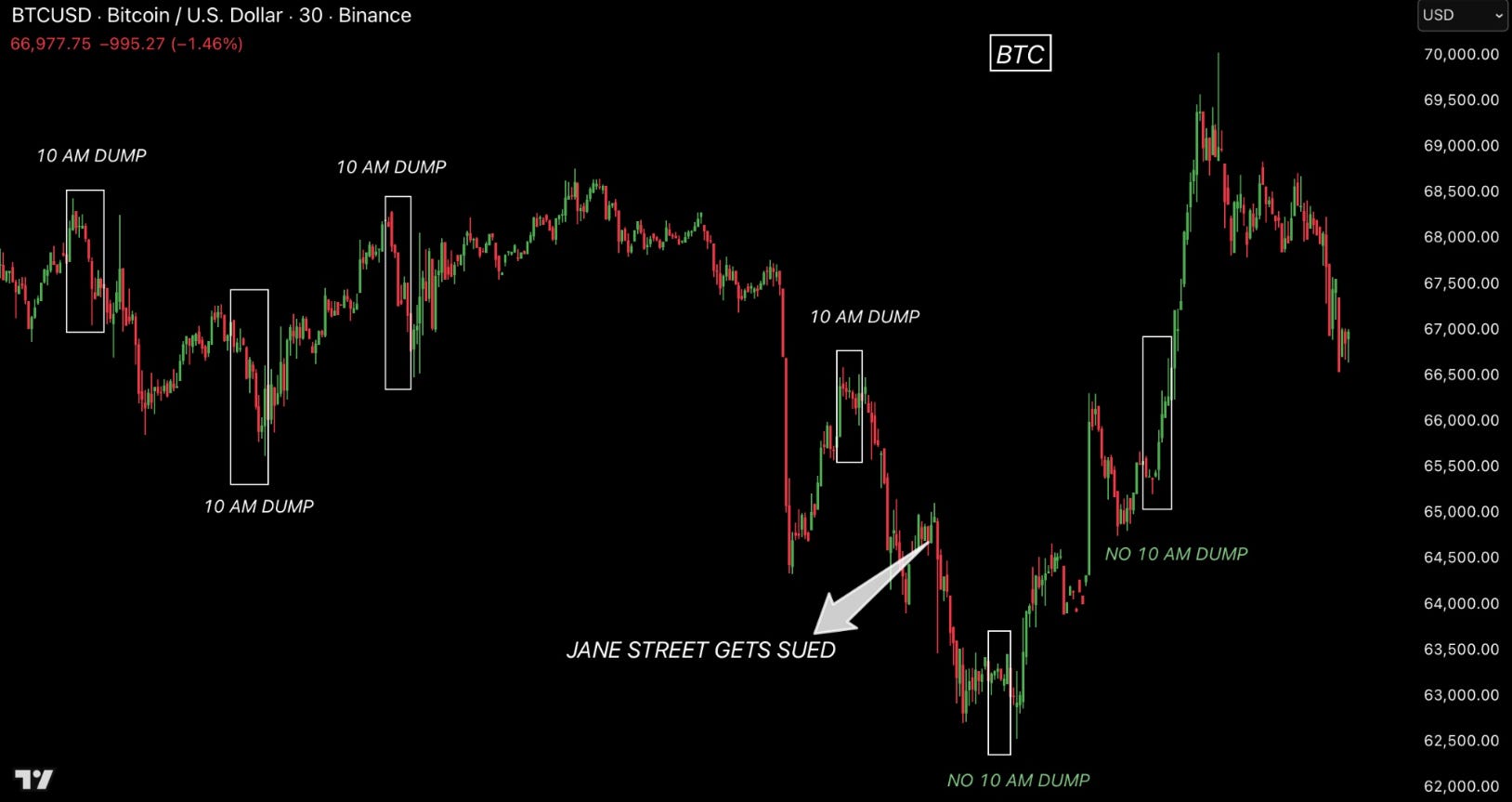
For months, people have pointed to repeated sell pressure around 10 a.m. just after US markets open. The pattern people highlight is a consistent, sharp downward move, leveraged longs get liquidated, forced selling cascades, and then the price stabilises.
Right after the announcement that Jane Street was being sued, there was NO 10 a.m. dump. Instead, a relief rally. Lol.
Simon, my Carrot Lane Live Co-host, chimmed in with his thoughts:
“I always think: follow the evidence. So if it is factual and true that this is happening consistently over a longer period of time, whether anyone would deem it legal or not becomes the question. And interestingly, would it fall under the Crypto Clarity Act if that were passed? That would be another interesting thing to see. If the facts are the facts, they can’t really be disputed. But I know things are often much more nuanced than that. Still, it’s a good starting point, isn’t it?”
Details below.
The Goldilocks zone for risk assets.
Multiple research firms have concluded that we are in a Goldilocks zone for risk assets.
Meaning it won’t be too hot or too cold.
Philip Saunders, director of the Ninteyone, said:
“After a disorienting period for markets, investors may find that 2026 feels unexpectedly balanced. We expect a Goldilocks environment. Not too hot, not too cold, characterised by firm real growth, falling inflation and improved earnings visibility across regions. But this outcome still requires thoughtful positioning. This is not a year to rely on a single narrative; it’s a year to be selective and diversified.”
A Goldilocks Economy is the sweet spot for markets.
Growth is strong enough that companies are making money and people have jobs, but it’s not so strong that inflation gets out of control. If inflation stays manageable, central banks won’t feel the need to aggressively raise interest rates.
For investors, that combination is almost perfect.
• Businesses keep growing
• Consumers keep spending
• Interest rates stay relatively stable
• Liquidity stays in the system
Felix-Antoine Vezina-Poirier, Chief strategist at BCA Research, said his findings were that:
“Overall, our survey delivered a Goldilocks signal of decent growth and disinflation. Historically, such positive momentum has coincided with equity outperformance versus bonds”.
The economy is stronger than most people think
If the economic outlook is good and people have more money in their pockets, that money eventually finds its way into risk assets.
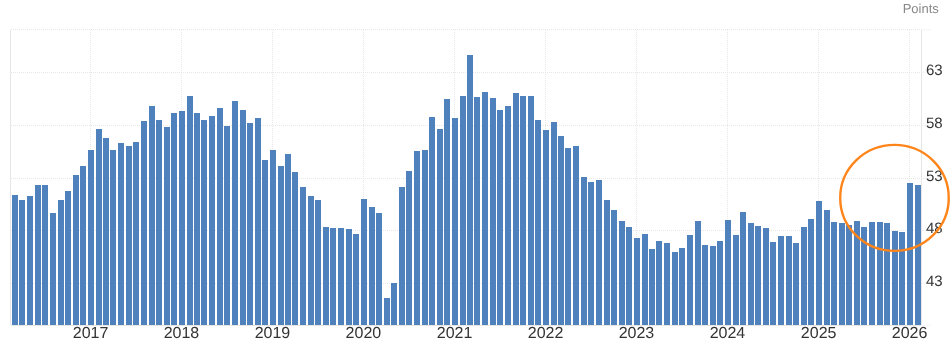
One of the earliest clues for that is the ISM.
The Institute for Supply Management runs a simple monthly survey that basically takes the pulse of the economy. It asks big-boy purchasing managers at big-wig companies one straightforward question: Are things getting busier or slowing down?
These are the people who order raw materials, deal with suppliers, and manage production lines. Because they sit right at the centre of supply chains, they often see economic changes before everyone else. If companies start ordering more materials or hiring more workers, it usually means demand is picking up. If orders get cut, it’s often an early signal the economy is cooling.
All those responses get rolled into one number called the ISM index.
• Above 50 means the economy is expanding
• Below 50 means the economy is contracting
Think of it as a speedometer for economic activity.
This matters for asset prices because markets don’t just react to what’s happening now. They move on expectations. If businesses are getting busier, productivity rises, companies make more money, and that eventually feeds into higher stock prices and stronger risk assets.
Macro investors watch the ISM like a hawk-eyed bookie because it helps them gauge where we are, so they can squeeze the lemon juice out of the economic cycle. Once they get that read, the game becomes pretty simple: put their chips on the assets most likely to benefit from that environment.
The ISM helps answer three questions.
• Is the economy speeding up or slowing down?
• Are interest rates more likely to rise or fall?
• Is liquidity about to tighten or expand?
They are the dominant forces in asset prices.
You can see below the two skyscrapers poking their noses out, currently showing a score of 52.4 and finally breaking away from that sideways chop. That’s despite Armageddon all over the timeline.
Final Thoughts.
24.9% of the $38.5 trillion US national debt matures in 2026.
Kevin Warsh, the man in charge of dropping rates, which would result in that debt being rolled over and asset prices essentially going to valhalla said in December 2025 on a podcast:
“This is the most productivity-enhancing wave of our lifetimes—past, present, and future. [...] The technology could prove to be structurally disinflationary [similar to the internet era]. [...] My sense is that the anecdotes will be there before the data,” forcing central bankers to “make a bet” on leaning toward cheaper borrowing costs (i.e., lower interest rates) in anticipation of this effect.”
He’s a Republican.
And he’ll drop rates faster than my diet after walking past the Krispy Kreme aisle. Warsh’s justification really comes down to AI making up for the productivity gap.
It’s my personal opinion that Trump hired him for one very good reason. After publicly chucking Uncle Jerome through the wood chipper for not lowering rates, the reason is to lower rates. Both Trump and his Treasury Secretary, Scott Bessent, are acutely aware of how rolling debt raises asset prices.
Printing casholla is a cheat code for making us all feel like a bunch of Rich Men North of Richmond.
Trump has the midterms in November, and I imagine he’ll do everything in his power to influence voters with a strong economy. It’s already showing signs in the ISM that productivity is picking up, and there's a sweet spot for investors because Bitcoin and Crypto are clearly not overheated, while the economy's backdrop looks much healthier.
If you just keep it completely simple, if the economy is better and people have more money in their pockets for discretionary spending, they’ll likely buy more magical internet money because of how sensitive it is to financial conditions.
If it doesn’t play, this fiasco will have been political suicide for the Republicans.
If you enjoyed reading this, please upgrade or share it with a friend or family member who might enjoy it too. That’s how Carrot Lane grows.
This article is for informational purposes only and should not be considered financial, tax, or legal advice. You should consult a financial professional before making any significant financial decisions.