

I’ve tried to write this piece three times this week.
The problem is, every time I come back to it, Bitcoin seems to have cracked open another can of Red Bull and formed another cup-and-handle pattern.
That, in itself, says something.
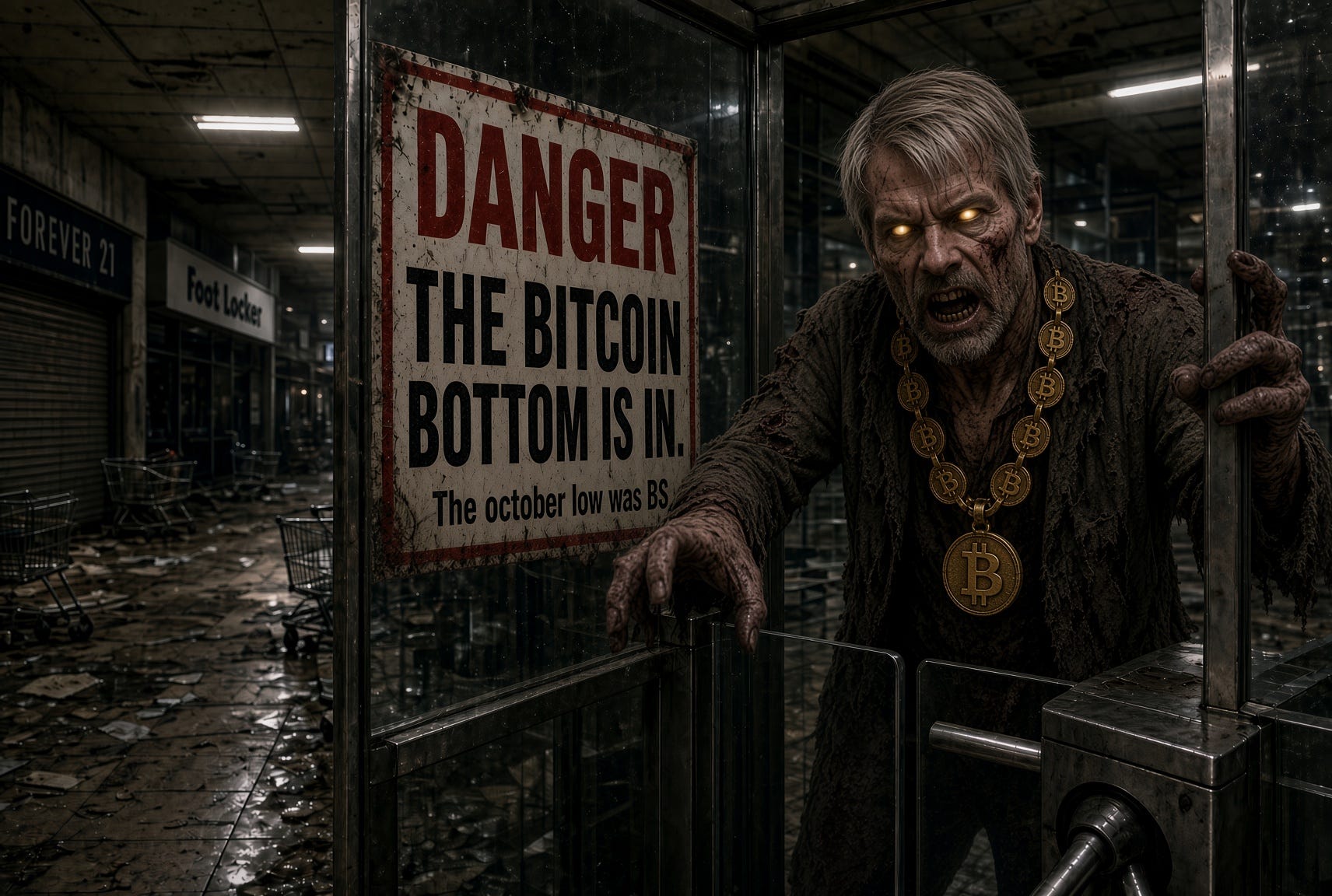
Over the last few months, so many people have messaged me saying, “The bottom will be October.” The thesis was built around the now-famous four-year cycle chart, suggesting Bitcoin’s low would come exactly 365 days after the previous cycle’s high.
No way, José.
It’s a truism in Crypto that if everyone thinks one thing, you probably want to start looking the other way. Or, as Chris Burniske would say: “If there’s a feeling of euphoria in either direction, you want to take the opposing view on that bet.”
He foresaw the October 10th, 2025 crash because he could see people loading up on leverage and playing the four-year cycle framework. Meanwhile, we were all fixated, like dopamine-fuelled crack addicts, on the M2 money supply chart that Bitcoin was literally mirroring.
That included me, might I add.
In my eight years in this space, I’ve come to one pretty simple realisation: the bigger risk isn’t buying an asset that could fall another 20%, 30%, or even 60%. The bigger risk is sitting on the sidelines while the highest-quality assets can outperform in such a ridiculously short space of time.
Which is exactly what we’re seeing now.
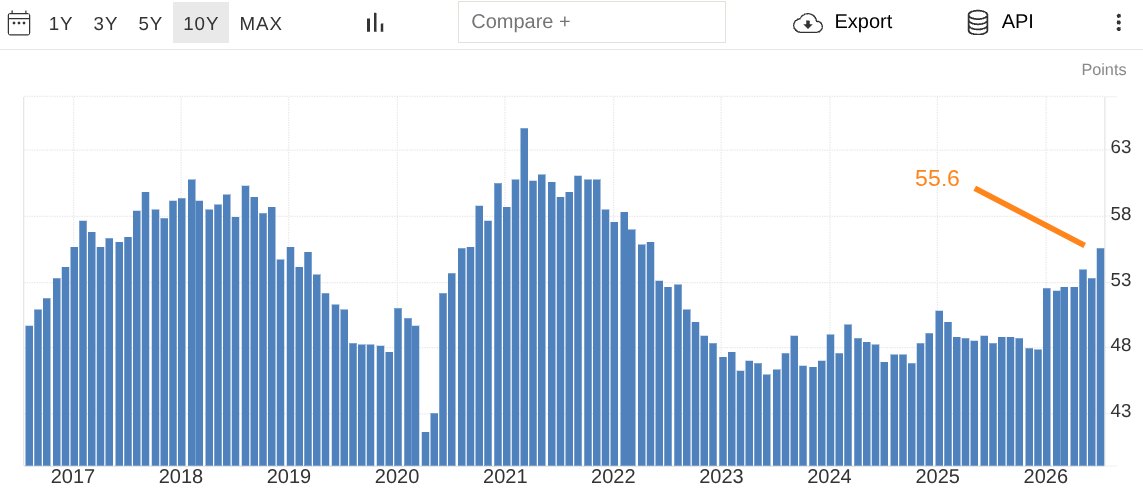
One framework I’ve leaned on heavily, and shared with this community for a long time, is the ISM.
The ISM (Institute for Supply Management) Manufacturing PMI is one of the simplest ways to understand the health of the economy. Every month, it surveys businesses across the United States to see whether conditions are improving or deteriorating. A reading above 50 means the economy is expanding, while below 50 means it’s contracting.
Today, that reading sits at 55.6.
That’s a strong number because it signals improving business conditions, which generally lead to easing financial conditions, stronger corporate confidence, and, ultimately, a greater appetite for risk assets.
While much of Crypto Twitter debated exact dates and tried to predict the perfect bottom, the backdrop underneath the market was quietly getting stronger.
I love the ISM chart below because, quite frankly, it’s been ludicrously accurate.
But its real value is that it gives you a mental framework for where we are in the cycle and, more importantly, puts a psychological shield between you and the market’s day-to-day madness.
And in crypto, that is gold dust.
Don’t underestimate the scale of the opportunity
One of the aha-apple-bouncing-off-my-noggin moments on my journey in this wild space was realising that we spend far too much time obsessing over the technology and not enough time looking at the people using it.
Think about the telephone.
We can all agree it was a world-changing piece of technology. But if I owned the only telephone on Earth, it would be completely useless. Users drive the technology’s additional utility, not the other way around.
The same applies to social media. Facebook didn’t become valuable because someone wrote elegant code. It became valuable because billions of people joined the network.
That, in a nutshell, is Metcalfe’s Law.
In simple terms, a network becomes more valuable as more people use it because every new participant creates more possible connections. Crypto, the ultimate money network, works in much the same way. Users become the network’s biggest proponents and, somewhat tribally, start fighting off competing ideas.
It’s why XRP army and Bitcoin Maxi’s exist.
As each cycle passes and our lives become increasingly digitised, that flywheel compounds. Only in the best networks, of course.
Famous macro investor Raoul Pal has often spoken about Metcalfe’s Law as one of the few observable frameworks for valuing crypto networks. More recently, he’s been talking about something potentially much bigger: Reed’s Law.
And this is where I think things get really interesting.
Most people’s valuation frameworks for Crypto are still based on humans adopting the technology. What they aren’t accounting for is the potential exponential effect of each of those humans eventually using 10, 20 or even 100 AI agents that could converge with blockchain technology and transact with each other.
Suddenly, we’re not just talking about billions of humans using these networks. We’re potentially talking about tens or hundreds of billions of human-directed AI agents interacting, transacting and forming their own networks on top of them.
Whether that plays out exactly as imagined isn’t really the point.
The point is that we’re trying to value something potentially exponential using linear thinking.
And that could mean we’re missing the forest for the trees.
“Elon’s talking about the robot being the largest single product ever sold. Okay, there’s a billion robots. Okay. That makes a difference.
But when you’re talking about 100 million, 500 million agents, we have no comprehension what that means. So the economic system just doesn’t function. It’s moving so fast now.
Almost all technological adoption in all of history has been Metcalfe’s Law. So they kind of grow in that log channel. Look at Google’s chart from day one, look at Facebook, look at the NASDAQ, look at all of them. They’re all the same chart. And that’s Metcalfe’s Law.
Now, the issue is AI is the first ever recorded example of Reed’s Law. So Reed’s was theoretical. It’s not observed in biology. We don’t see it in things like viruses. It doesn’t exist.
Now it exists.
And so what we’re seeing is Reed’s Law is Metcalfe’s Law squared. So it’s the exponential of the log channel. The exponential of the exponential.
So, to put it in terms people understand, ARK put out a piece of research showing the estimated annual output of words of all of humanity each year, from the Gutenberg press in 1500 to today.
AI, in three years, has now exceeded per year all of the output of all humans on Earth in terms of words.
By 2028, so this is now, call it six years, five years after AI really came out, it will produce more words than all of humanity has ever produced in sum total.”
My highest conviction bet this cycle
There’s an old saying that you earn your stripes in the trenches, not when everything is going your way. SUI has been exactly that kind of trade.
I know many of you followed me into SUI. Some of you have been here even longer, from the Solana article I wrote when it was around $8, while others joined after I wrote about the Bitcoin lows. I never take your trust (or your attention) for granted.
The reason I’ve leaned so heavily into Layer 1s is simple: I’d rather own the infrastructure than try to guess which individual application wins.
Buying a Layer 1 is essentially owning the protocol that hundreds, or eventually thousands, of businesses can build on top of. You’re backing the rails rather than trying to pick every train, and on a risk-adjusted basis, that has always made more sense to me.
SUI has been that bet.
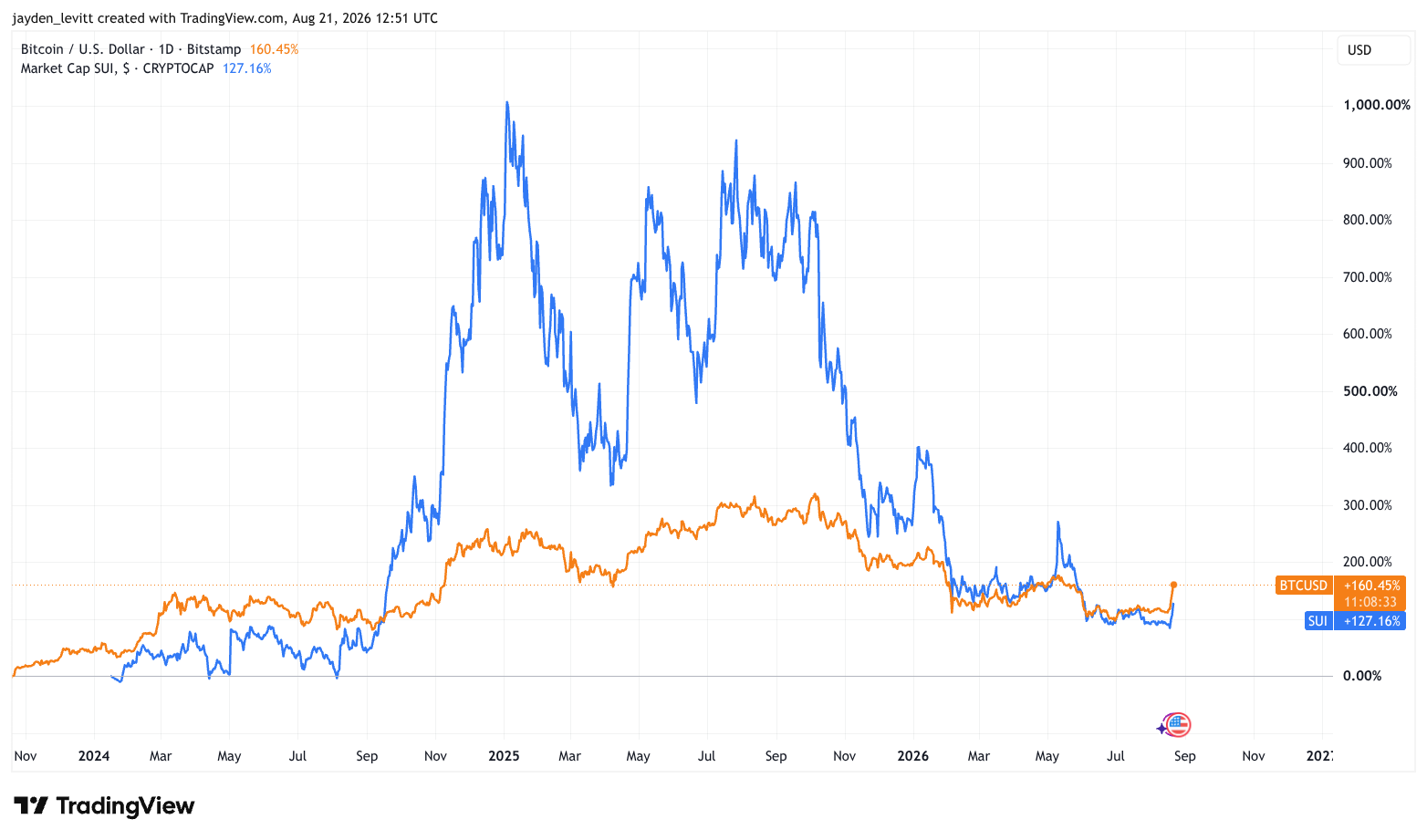
It generally moves in the same direction as Bitcoin, but because it’s newer, smaller and less liquid, those moves can be far more amplified. That cuts both ways, which anyone who's held it over the last year knows all too well.
At one point, SUI fell 70%+. That’s stomach-churning, but nobody gets to watch you sit through a drawdown like that and then tell you the upside was luck.
If you continued to dollar-cost average through that downtrend, you’re now beginning to feel the compounding benefits of patience. And having a full-sized set of kahunas.
If you bought near the highs, that’s okay too. Almost everyone who’s been around long enough has top-blasted a token. I wanted to crawl into a ball when I bought Ethereum at $150 and watched it retrace to $80.
We all know how that played out.
The lesson is that sometimes it just takes time for these things to play out. That’s also what the chart below illustrates beautifully.
SUI in blue broadly mirrors Bitcoin in orange, but the swings are much more violent. When Bitcoin falls, SUI can bleed harder. When Bitcoin moves higher, that same relationship can create amplified moves in the opposite direction.
That volatility is the price of admission.
The potential outperformance is why we’re willing to pay it.
Art on the Blockchain
Art has always lived on the medium of its time.
On cave walls, on the sides of buildings, on pavements, on canvases and even on pieces of cardboard like Pokémon cards, being the contemporary art of our generation.
Art now lives on the blockchain.
Our generation grew up online. We’ve built friendships, businesses, and entire careers online. So it makes perfect sense that our generation’s contemporary art also exists online.
NFT art captures internet culture. The difference is that, for the first time, digital art has built-in scarcity, built-in supply friction, verifiable ownership and permanent provenance. Those are the exact characteristics that have made physical art valuable for centuries.
Art sits upstream of wealth, and there’s now an extraordinary amount of wealth inside crypto.
One thing many people overlook is the relationship between NFTs and Ethereum. NFTs are a huge function of the Ethereum ecosystem. When ETH appreciates, ETH holders' purchasing power increases, creating what often feels like a multiplier effect for culturally significant NFT collections.
What is extraordinary is that Art Price researched 47,000 contemporary registered artists and found that 85% of the value accrues to just 100 of them, which makes the $1.5 billion in value roughly the same as the entire NFT market cap today.
So, if you pick the right artists, and without me overreaching here, it could genuinely change your fucking life.
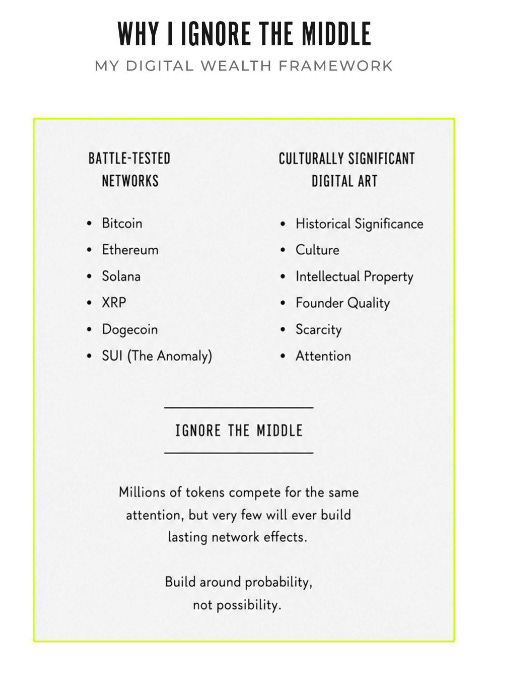
This is why I continue to believe the greatest opportunity isn’t chasing endless meme coins or micro-cap tokens with unlimited competition and endless supply. Too many tokens are competing for attention, and liquidity is spread far thinner than it was five years ago.
That’s why I still believe in the barbell approach: own battle-hardened blue-chip assets on one side and culturally significant digital art on the other.
The edges are where the opportunity lives.
Final Thoughts
There’s an old saying that everyone looks like a genius in a bull market, but the actual genius is still having some irons in the fire when it arrives.
I’ve had countless messages asking me where prices go from here.
The truth is, I don’t know. Nobody does. And after three cycles in Crypto, I’ve realised that trying to predict every twist and turn is usually where people tie themselves in knots.
What I am confident in is the framework.
Using indicators like the ISM to understand when financial conditions are improving. Building positions gradually. Scaling out gradually. Owning the right assets. And, above everything else, managing your emotions when the market inevitably tries to slap the conviction out of you, like when Mom came at you with a slipper.
The biggest lesson this cycle is to stop thinking you’re Nostradamus and trying to predict the future. Note to self. Avoid getting pot committed to speculative bets while the obvious trend is staring you squarely in the face.
Bitcoin. Ethereum. Solana. XRP. DOGE. SUI.
Then, for those willing to venture further out on the risk curve, culturally significant digital art.
Where I think people are missing the forest for the trees is that this isn’t the same Crypto market we were investing in 5 years ago. Back then, governments were talking about banning it. The SEC was suing large parts of the industry, liquidity was tighter and institutional participation barely existed.
Today, the playing field couldn’t look more different.
Crypto has become a social trend. People proudly stick “Investor” in their bios, and almost everyone I speak to owns some combination of Bitcoin, Ethereum, Solana, XRP or a shit coin that tasted like regret.
The beauty of this cycle is you get to be the second mouse that gets the cheese.
You can put meaningful size into assets unlike those tiddly little bits people were parking their cash into in 2017. It’s because these right assets have already survived bear markets, regulatory attacks, hacks, crashes and 47,000 declarations that Crypto is dead, yet still have an enormous runway ahead of them.
It’s the moat Uncle Warren Buffett has talked about for decades, just applied to Crypto. The strongest networks become increasingly difficult to displace because the users, liquidity, developers, applications and attention start compounding around them.
You don’t need to find the next obscure token hiding under a rock and pray it does 100x. Sure, have a punt, but put that firmly in the “fun” category, somewhere under dopamine shot in the arm.
Sometimes the biggest opportunity is the one sitting right under your nose. Capture the obvious trend. Have a framework. Give the best assets enough time to do the heavy lifting.
Now the real opportunity in Crypto begins.
This content is for informational purposes only and should not be considered financial, tax, or legal advice. You should consult a financial professional before making any significant financial decisions.
I have 3 tabs open on my browser I check every morning at coinmarketcap.com. BTC, SUI, XRP. I only own one, but it’s fun to see the other two go up and down following “daddy” - I’ve never doubted BTC, as a HODLer 😉