

Life peaked as a kid from South Africa, plugging in my Nintendo 64 and playing Golden Eye for the first time.
How could anything ever be better than that?
Now technology is sprinting ahead faster than a pack of cheerleaders fleeing from drunk middle-aged men.
It’s as if AI and Cryptocurrency are rewriting the rule book while on a collision course with each other.
Fast forward 20 plus years, I’m now living in the UK, which appears to be an attractive hub for technology nowadays, especially as our friendly neighbours (and Gary Gensler) across the pond in the US are bashing innovation with the sledgehammer.
AI is converging with Cryptocurrency, and the Blockchain is quickly becoming crucial in verifying the truth. We already see the collateral damage with instances of AI identity theft on the rise, and they’re getting more believable by the day.
Public figures have been the main targets. President Biden was recently portrayed in drag, endorsing Bud Light, and Trump was teaching tax evasion in an Albuquerque nail salon. It’s both amusing and alarming, but the dangers of trickery and deception can have lethal consequences.
Super bright innovators like Sam Altman, who’s the new Silicon Valley poster boy, know this, so he’s released Worldcoin in the hopes of verifying every human identity on the internet and all while keeping your information private and enticing you with free money, just for being a human.
Altman wants to crack the code of verifying digital “humanness”.
Identifying who you are in an open source way that you can keep your information private lays the foundation for a whole bunch of other stuff to become a reality.
Imagine logging into your social media applications, accessing your bank information and Cryptocurrency using your eyes. Or even getting a decent night’s sleep because you’re not worried sick that you’ll lose your seed phrase. You’ll have your eyeballs as a backup.
It’s profound.
Here’s the short version of what Worldcoin is aiming to do.
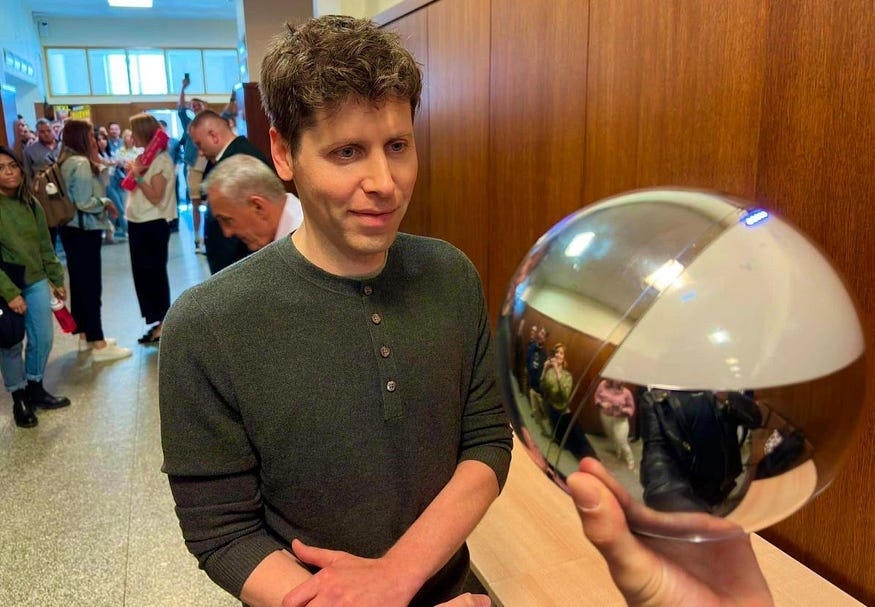
It uses an “orb” (a round object the size of a soccer ball) that scans your eyeballs to prove you are a unique human to create a global identity and financial network for everyone.
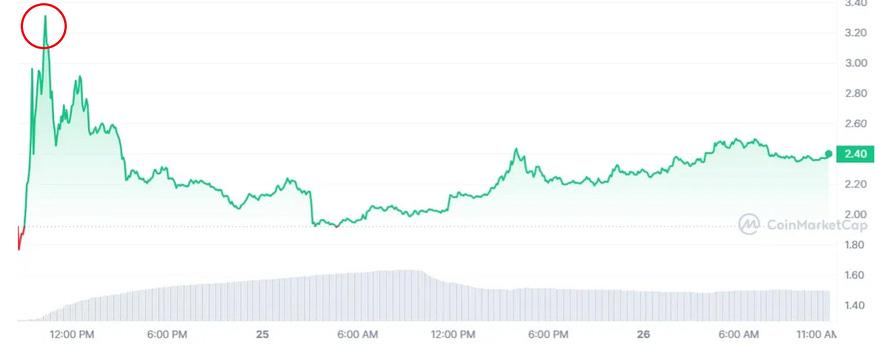
When you’ve scanned and verified, Worldcoin org rewards people with 25 WLD coins (currently trading at $2.40 a coin with a market cap of $260 million as of publishing)
Worldcoin Org has already onboarded over 2 million people but intends to scan every eyeball worldwide.
Worldcoin is not available in the US. Send thanks to Gary!
The process involves looking into the silver Orb for an Iris scan ( the coloured part of a person’s eye) to prove your human identity.
To complete the verification, you link it to your mobile phone from an App. You’ll receive 25 Worldcoin coins valued at around $2.40 each, giving you a free $60.
This concept might be strange and dystopian, going through such a process to get cryptocurrency coins. But as usual with Crypto, people are drawn by the possibility of financial gains and the underlying idea.
Sam Altman, CEO of OpenAI, emphasises the cryptocurrency coin is not the primary goal. It’s more about proving your human identity online and differentiating yourself from AI chatbots that are increasingly lifelike.
One fascinating use case is Worldcoin’s Universal Basic Income (UBI) capacity. Like that sweet bat virus cash that rained on us, it helps Sam, his pals and Government know who to send money to in case of an event requiring aid.
Digital identities, in this one use case, limit fraud and increase processing speed.
Let’s Address the Elephant in the Room (People Are Sh*tting Bricks About Having Their Eyeballs Scanned).
Sharing our information with platforms like Facebook, banks, credit card companies, and insurance providers has become commonplace. And you know what? It benefits us big time — until you sh*t your pants when you see a social media advert based on a conversation you had with someone offline.
Every day, numerous things around us already store biometric information.
Smartphones
Gaming Devices
Laptops & Computers
Virtual Reality Headsets
Biometric Attendance Systems
Understandably people are taking it all in with a large pinch of scepticism. And who can blame them?
Altman has set out to build the world’s most significant identity and financial network as a public utility and says he’s giving everyone ownership but keeping 9.8% of the supply.
With a seemingly delusional scale of ambition, Sam managed to secure financial backing from heavyweight investors such as Andreessen Horowitz, LinkedIn founder Reid Hoffman, and Sam Bankman-Fried (The famous curly-haired guy who sent FTX to zero).
It certainly appears as though Altman sees this as a long shot in development, going by his comments after the launch.
Sam Altman — Source
“I don’t remember who I first heard this from, but there’s a somewhat famous saying; If you knew how hard it would be, you would never start.
So you must be a little naive at the beginning, but smart, driven, aligned small groups of talented people can accomplish so much more than they realise because their comparison is working in a big company or being in school or something like that.
But even then, the Worldcoin team certainly outperformed expectations, even adjusted for that.”
The Twitter Skeptics Said What Everyone Was Thinking
Despite the dangling carrot of free money, the Eyeball scanner isn’t winning everyone over.
Albert Nash, a Twitter blue subscriber, who seemingly is happy for Elon to have his information, is concerned.
Twitter User — Source
“I want more info on the Iris scan. I see the iris scan as revealing exponentially more personal data about yourself.
Technology will allow any screen or monitor CCTV system to quickly pick you out of a crowd, even if you were disguised.
Especially with the advancement of VR systems that are being developed by every tech giant at this very moment that’ll probably hit the market within the next two years.”
Free Money Talks Louder Than Free Data
After collecting more than 2 million users during beta, Worldcoin said it will ramp up its eyeball-scanning operations to 35 cities across 20 countries.
For 15 years following the launch, the supply cap will be 10 billion WLD with an initial circulating supply of 143 million WLD (enforced by the WLD smart contract).
After 15 years, governance may decide to implement an inflation rate of up to 1.5% per year if it deems it necessary for the long-term sustainability of the protocol.
Shortly after launching, WLD reached a price of $3.38 and a market cap of $345 million. At its peak, your 25 free WLDs were worth just under $85 and free for every person to claim on the planet.
What a time to be alive.
Final Thoughts.
For some people, this might seem like a Central Bank Digital Currency (CBDC) but without the “CB” (Central Bank) at the beginning.
If you’re a Bitcoiner, you’ll look at this very seriously because of identity verification and the creation of a new payment platform, network, and currency to go with this identity verification.
It will make you question your thesis that maybe Bitcoin won’t be the only global network.
There is zero doubt in my mind that we have to have some way of identifying people that protects us from bad actors in the echo system but also keeps our information private.
We’ve been giving up our information for years. Central planners and criminals can access those things, and it’s a system that doesn’t work. The beauty of decentralisation is it’s trustless.
I’ve already downloaded the World Org App (not linking it).
I’m unsure if I’ll travel the 200-kilometre journey to London for my $60 WLD coins. But if you’re on the fence, Sam Altman manages your Worldcoin expectations perfectly in his white paper.
Sam Altman — Source
“Worldcoin is an attempt at global scale alignment, the journey will be challenging, and the outcome is uncertain. But finding new ways to broadly share the coming technological prosperity is a critical challenge of our time. We hope you’ll join us”.