


Today’s newsletter is made possible thanks to paying subscribers. If you want access to the full paid content, consider upgrading to an annual membership, which includes a free 1-to-1 call and saves you 31%.
I’m noticing a theme.
Whether through DMs, livestream comments, or folks I speak to on calls, is that many are becoming pot-committed to micro-cap tokens, we’re talking assets with market caps under $500 million.
Me being sceptical is an undertatement.
The monumental landmine everyone will tread on is that there are too many tokens in that echelon of assets. Even if the token has a high memetic ceiling, the team is profound, or you genuinely like the technology, it still requires attention flows for it to drive buying pressure.
It’s the simplest and most underestimated explanation for what drives the price.
Price increases become a self-sustaining marketing tool because it drives more eyeballs to the asset, which in turn creates the next wave of buyers. That’s how these network adoption models can have parabolic price rises. Right now there’s too much diluted attention in these tokens and too many assets competing for the same capital.
Most people are better suited to sticking to one of the five battle-tested assets that are either Bitcoin or indexed against BTC, while simultaneously not letting NFTs become a blind spot. So playing on either end of the barbell in obvious coins and then culturally significant NFTs.
I believe NFTs are the Crypto opportunity everyone is overlooking.
We can now clearly see that the top 100 NFT projects by market cap are all up in percentage terms, while Ethereum, the underlying currency used to buy these assets, and Solana and Bitcoin have traded sideways. That’s significant because when Ethereum rises, the NFT becomes a leveraged bet on ETH, and you get this multiplier effect, which is why it tends to outperform.
In other words if you buy an NFT for 1 ETH and the buy-and-sell demand pushes it to 10 ETH, that’s already a great return. But if Ethereum itself also moves from today’s price of $2,300 to $10,000, that same NFT has effectively gone from $2,300 to $100,000.
That’s the magical multiplier effect. And in the right NFT asset, it’s a swing most people should at least consider taking.
In a world where everything digital is basically infinite, including coins, NFTs solve one very important problem: scarcity.
The beauty of the asset is its built-in supply friction: the psychology of the holder is that, as the price rises, they become less willing to sell, which means it trades hands less often.
Most holders tend to buy one from each collection and sit on it. Because the first use case is art, and humans socially signal through art, people organise around these assets. They meet online and in real life. It makes the experience of holding the asset much more immersive than coins, which then makes that one token much harder to sell because, in many cases, selling it feels like stepping away from your friendship group.
As Punk6529 says, the nature of the token shapes the holders, who in turn shape the nature of the token:
The single most important test, is can I imagine myself saying (or the token hodlers saying): "I have no intention of selling this token, I plan to give it to my grandchildren when I die and I hope they don't sell it either"
Selling an NFT feels like amputating part of your identity.
And right now, the behaviour pattern we are seeing in these NFT assets is that they operate much like coins, in the sense that they are network adoption models. It’s now a race to the top for the strongest networks, and all that really needs to happen is for these online communities to survive and develop a Lindy effect. If they survive a downtrend, they become increasingly difficult to displace because each new cycle increases the likelihood that these non-perishable assets will remain with holders rather than be sold.
Art has been upstream of wealth for hundreds of years. But the NFT technology itself operates more like a QR code on steroids, where the issuer can add anything of value to the contract layer in perpetuity. That makes the asset much more dynamic than most people realise.
It truly is an everything token.
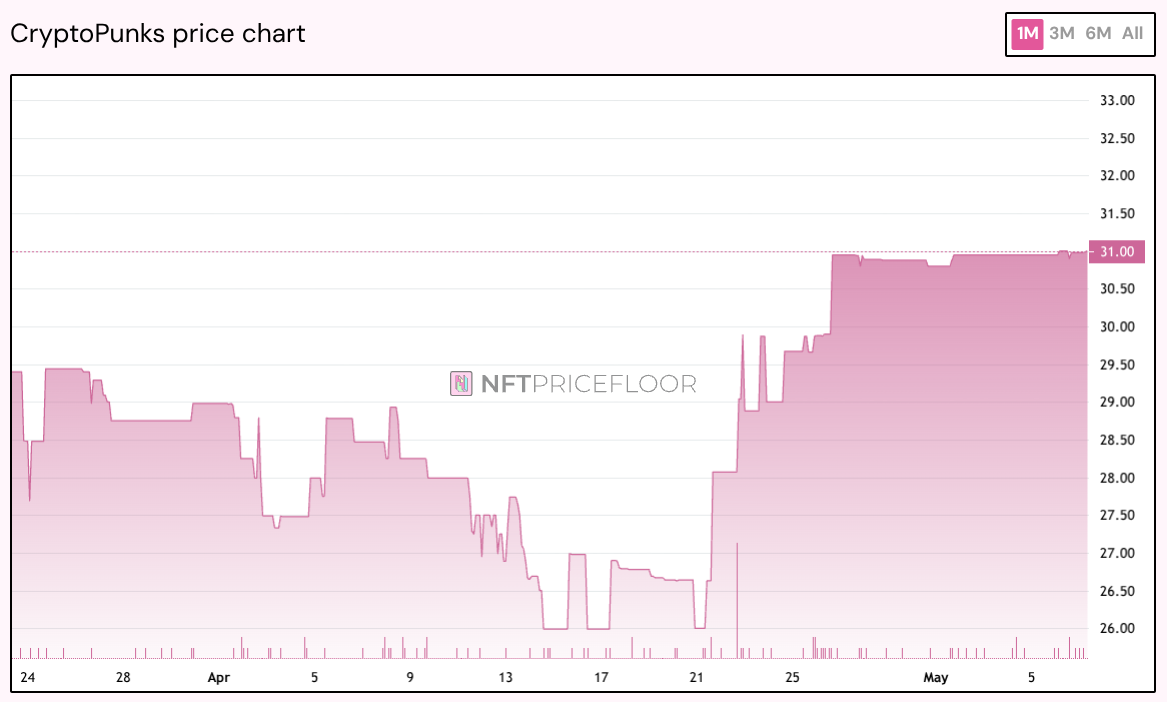
What we’ve seen over the last 30 days is that CryptoPunks, which acts as an index for the NFT market in a similar way that Bitcoin does for altcoins, has been moving higher, and that’s starting to have a knock-on effect across other blue-chip collections.
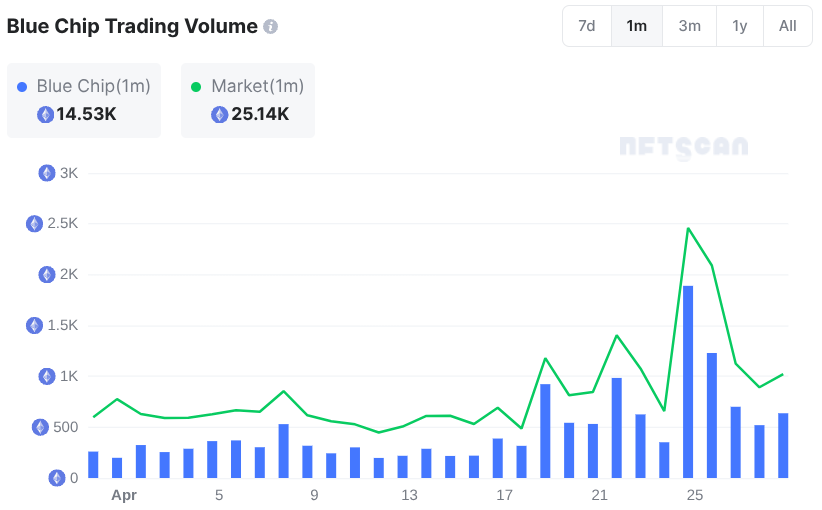
Blue-chip trading volume.
Something’s starting to shift under the surface.
Trading volume on blue-chip NFTs is up substantially. It’s picking up in a way that’s hard to ignore and the market is still nowhere near all-time highs.
What NFTs are showing right now is that this is becoming a race to the top for the strongest communities.
You can already see the early signs in the data, with a clear uptick in trading volume, something a lot of notable commentators have started pointing out on the timeline.
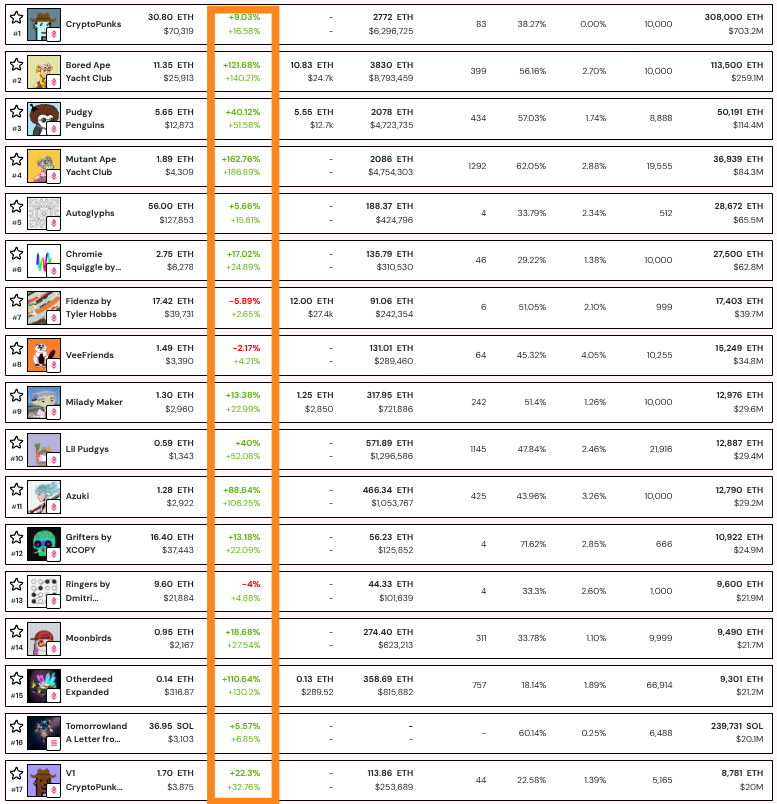
BAYC: 11.26 ETH
Pudgy Penguins: 5.59 ETH
MAYC: 1.89 ETH
All green.
This isn’t one collection pumping.
It’s the entire blue-chip tier moving together.
When correlations tighten on the way up,
it’s usually macro rotation not project specific news.
Capital is rotating back into NFTs.
The floor doesn’t lie.
“NFT Market Cap Tops $2 Billion for First Time Since January
CoinGecko data shows the total NFT market value at around $1.95 billion in early May 2026, with daily sales over $2.5 million amid a broader crypto bear market.
Blue-chip collections are driving the rally, sparking chatter about undervalued gems that hit $15 billion at their 2022 peak.
Enthusiasts like CryptoKaleo predict big growth in a bull market, while communities share nostalgia for OG projects, blending hype with long-term belief in art and culture.”
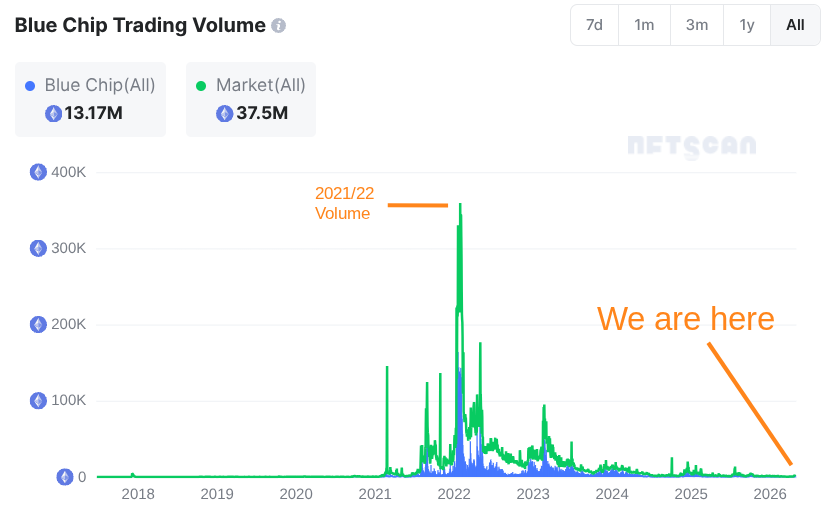
Let’s ground this data.
When you zoom out, the chart below shows where we are in all-time blue-chip NFT trading volume. The NFT market cap is now $1.9 billion, which is up over $700 million in the last 30 days alone, but it’s barely a speck on a chart compared to where we were in 2021.
To put that into perspective, the entire crypto market cap is roughly $2.6 trillion, with NFTs accounting for just $1.9 billion, or 0.07% of the total.
That’s minuscule.
To borrow Punk6529’s expected value framework, there is a 50% chance that NFTs double and account for 1.4% of the total crypto market cap, and a 50% chance they go to zero.
So you stay delta neutral: 50% × 0.14% + 50% × 0% = 0.07%. That’s roughly where we are today.
I like this probability framework for anchoring decision-making because it gets you closer to thinking in outcomes, not certainties, while also factoring in that crypto itself is expected to grow as a share of the total investable asset market.
If you take the total investable market at around $200 trillion, and crypto today sits at $2.6 trillion, that’s roughly 1.3%. Using the same framework, there’s a 50% chance that doubles to 2.6%, and a 50% chance it goes to zero.
Personally, I think the chances of NFTs doubling their share of the crypto market from here are significantly higher than the chances of them going to zero, which makes the expected value positive.
And that’s before factoring in that crypto adoption itself is likely to increase over the same period, meaning the total crypto market cap, currently at $2.6 trillion, could realistically grow to $10–15 trillion this cycle. And if the expected value is positive, it makes sense to have some exposure to the best-performing NFT assets, given their finite supply and the multiplier effect of Ethereum rising.
But the real fuel may come from trading card games and this hybrid model of phygital collectables, where companies like Courtyard.io are spending $80 million a month on PSA-graded cards, which are largely sold as digital receipts (NFTs).
With the world becoming increasingly digitised, the odds of higher prices continue to increase, particularly when you’re buying historically and culturally significant art, where there is always a reason for people to return to it.
Right now, we just need time to do the heavy lifting.
Over time, holders become increasingly unlikely to sell, while new demand is likely to keep coming in.
If we reach the volumes we did in 2021, we’ll have some crazy moments.
The data is quietly disagreeing with the crowd.
One of the truisms of the crypto space, especially when we’ve seen ludicrous assets like memecoins based on obscure ideas run into the billions in market cap, is this:
If you’re having an allergic reaction to something, someone on the other side of that trade is having a positive one.
And the only thing you need to do, if you want to be successful in this space, is find out why.
Like an old cricket coach used to say to me when I was underperforming as a batter and trying to cover it up by pointing the finger elsewhere: “Jay, there’s no hiding place for data.”
And it’s true of NFTs right now.
I read so many comments from people in denial, or saying things like “NFTs are dead, bro.”
But the data says otherwise.
I’ve crammed as many as I could below into one chart, but all of the top 100 NFTs by market cap are up by multiples.
Final Thoughts
Ever hear those stories of people who got into assets early, like the early Bitcoin or Amazon crowd, and you sit there wondering how they saw it so early?
That’s where we are with NFTs.
I think it’s the second bite of the apple, where most people are still carrying that early PTSD from missing Bitcoin and defaulting to denial.
Most people still think NFTs are a bit faddy, when in reality they’re one of the only things in crypto that make real sense as a use case, because they’re effectively an everything token.
So now is the time to lean in or at the very least get educated.
You might be sitting there as someone who already holds crypto but is still very new to NFTs, so as a thank you for reading this far, I’m going to make some suggestions on assets to look at, and I’ll link the projects below.
All are risk adjusted entries into the space. But I will say this: you need some kind of moat around your assets, and it all hinges on sustained attention.
There are three catergories I lean towards.
First, historically significant art, where you only need time to do the heavy lifting because there’s always a reason for folks to come back to them. You can’t go back an recreate that first or early moment. Most people don’t realise there is an entire antiquities market in NFTs.
Second, culturally significant art that captures a moment or movement, like top artists XCOPY and Beeple.
And third, IP plays.
These are much harder to get right because they depend heavily on the founder’s ability to drive demand, and you also need confidence that they have an altruistic view of business and will see the project through. It’s akin to investing in a start-up.
The most obvious thing people miss about NFTs, aside from their first use case being art, is that we’ve all grown up on the internet, and NFT art captures internet culture, which means there will always be demand.
The only cost of entry is an open mind.
Do your own research. But I recommend these as a soft entry into the space.
Today’s newsletter is made possible thanks to paying subscribers. If you want access to the full paid content, consider upgrading to an annual membership, which includes a free 1-to-1 call and saves you 31%.
This article is for informational purposes only and should not be considered financial, tax, or legal advice. You should consult a financial professional before making any significant financial decisions.