
The NFT Project No One Saw Coming—but Is Positioned To Shock Everyone.
The clue lies in where the capital is flowing from—and there’s a lot more on the way.

Today’s newsletter is free thanks to the amazing members who support Carrot Lane with a small fee.
Their support helps me create even better, more valuable content—and I’m incredibly grateful for it.
This was a joy to write, and I’m excited to accumulate more pieces from this project. Enjoy.
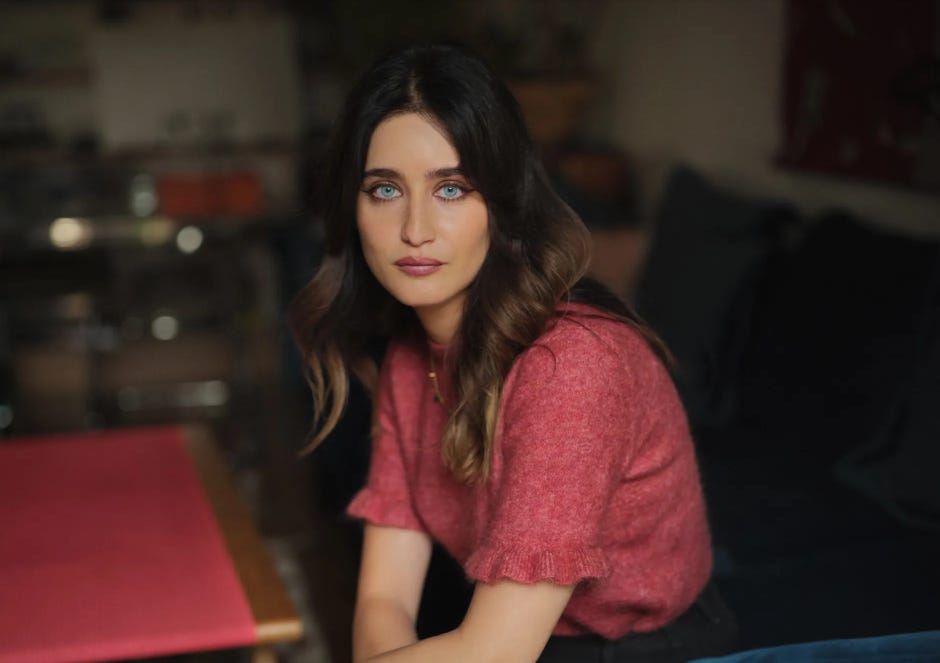
Yam Karkai went to bed after launching her NFT project, World of Women, having sold only 15% of the collection—only for her partner to wake her up and say, “There’s this guy called Gary Vaynerchuk in our Discord.”
After Gary shared the collection, it made 1.5 million dollars on the initial sale.
“The feeling was like nothing I’d ever experienced,” Karkai said. When she called her mum with the news, her mum cried. Her dad? Pure disbelief. “This isn’t normal,” she remembers him saying. “People don’t do things like that overnight.”
I remember walking around my park during lockdown to get out of the house earlier that day during the height of NFT mania, and suddenly, my phone buzzed.
I got a Discord notification to show that Gary Vaynerchuk, who is like the oracle of investing, posted a video in the chat.
I clicked the video, and he was casually sitting there in some shorts, no t-shirt, talking about an NFT project that was minting.
Now remember, we were in the height of mania, and every single project that had anything resembling a safety signal from anyone in the space would literally 10x in a matter of hours.
So I cut my walk short, sprinted home, flicked OpenSea up, connected my MetaMask, and went to buy a World of Women NFT. To my horror, the floor price had jumped to 0.7 ETH—from memory, it minted at 0.07 ETH.
My immediate thought was, ah, I missed it. I'll wait for it to come down.
Later that year and early in 2022, the floor price jumped to a high of 15 Ethereum while folks were punch-drunk. Many celebrities, such as Logan Paul, Reese Witherspoon, Gwyneth Paltrow, and others, started sharing their World of Women NFTs on their social media channels.
Now that the initial hype has died down, let’s buckle up and take a closer look under the hood.
What started as online hype turned into a real-world movement.
While I missed my chance to snag a World of Women NFT early on, the projects impact was impossible to ignore.
By 2022, WoW was everywhere.
(author note: I have since come to my senses and gotten exposure to this project)
One of the most significant moments came during Women’s History Month when Christie’s auctioned a WoW NFT for $750,000. The buyer used MoonPay to seal the deal, and suddenly, WoW wasn’t just making noise online—it was commanding attention from the traditional art world.
Fast forward to VeeCon in Minnesota, 2022. The buzz around WoW hit me like a freight train. The line to meet Yam was insane—easily the longest for any NFT founder at the event. It was a loud, unmistakable signal.
IRL (in real life) meetups taught me the value of boots on the ground—you can’t fully understand the space without being there. I remember thinking, this feels different.
Later that night, I ended up at an afterparty packed with NFT holders. The energy was off the charts.
WoW wasn’t just an on-chain concept anymore—you could feel that online expression had become something real.
Thoughts and feelings are ok, but everything is down to supply and demand.
I’m all for buying into the hype of a strong community, but as Raoul Pal says—you’ve got to be a mercenary with your money.
After spending a lot of time analysing projects, one core principle always stands out. It’s the one law of supply and demand.
That’s why I think WoW is seriously undervalued.
Here’s the deal: it’s not just one of the first female-led NFT projects—it’s the first to really gain traction and make a name for itself. That kind of early momentum is gold in a space where first-mover advantage is everything.
NFTs follow the same principles as crypto and Metcalfe’s Law—every new user adds more utility to the network. But NFTs take it a step further. They bring an emotional layer with real-life meetups, online social signalling, and a strong sense of community.
I’m in communities where people have literally hooked up through NFTs—wedding invites might not be far off.
Here’s the wild part: only about 5% of the NFT space is made up of women. That means more than half the potential consumer base hasn’t even arrived yet. Studies have shown up to 78% of females are inclined to support female-based businesses.
It’s like the early Web 1 days when people thought the Internet might only be for men because adoption was so skewed. But by Web 2, women made up over 58% of consumer participation.
If history’s any guide, WoW is sitting on a tidal wave of untapped demand. It already locked in the social consensus of the last NFT cycle, and as more people—especially women—enter the space, this project looks primed for serious growth.
Supply and demand don’t lie.
WoW isn’t just a project—it’s a movement. That’s why I see it as one of the most undervalued plays in the market right now.
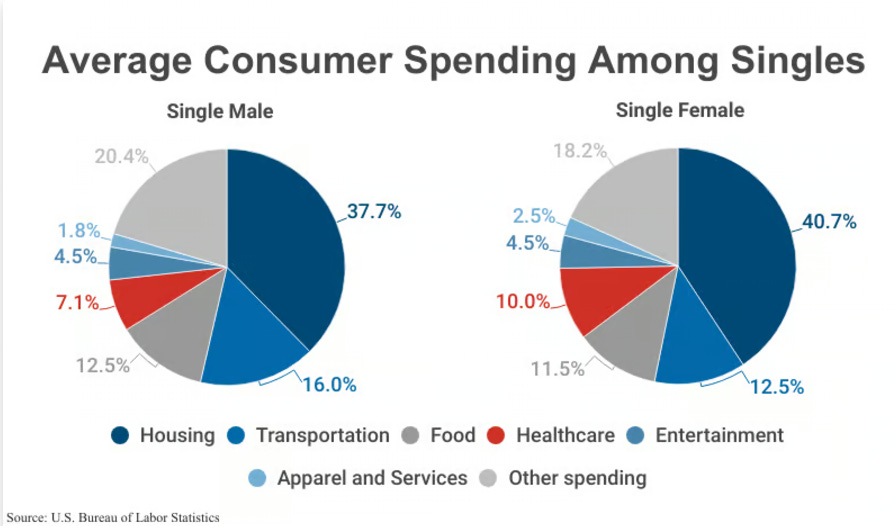
Overall Spending:
Globally: Women are responsible for approximately 70% to 80% of all consumer purchasing decisions worldwide.
United States: Women account for 85% of consumer spending, amounting to around $14 trillion.
Annual Expenditures
The average annual expenditure for men is $35,018, slightly higher than women's $33,786.
Shopping Preferences
In-Store Shopping: 65% of women prefer purchasing in-store compared to 60% of men.
Online Marketplaces: 43% of women regularly shop on online marketplaces, surpassing the 32% of men who do the same.
Product Categories
Clothing: Women are more likely to purchase clothing online, with 58.68% having done so in the past year, compared to 41.37% of men.
Online Shopping Trends
A higher percentage of women (53.4%) shop online compared to men (46.6%).
Men are slightly more likely to browse retail items online, with 53% preferring online browsing over in-store, compared to 44% of women.
Spending Categories
Apparel: Single women spend $671 annually on clothing and services, while single men spend $398.
Where attention goes, capital flows.
World of Women has built-in supply friction with its two collections.
The OG 10,000-piece set focuses on diversity and empowerment, while the 22,222-piece World of Women Galaxy (WoWG) collection expands access at a lower price entry without losing its exclusive vibe.
What makes this conversation interesting isn’t celebrity involvement. Celebs don’t have the same pull in NFTs as they do with Web2 consumer brands—many have flopped. Instead, the real signal is in the collector base.
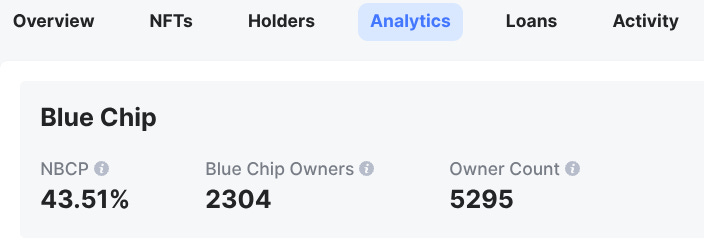
Right now, 170 CryptoPunk holders also own WoW. 370 BAYC holders and over 500 Meebits holders do too. That’s a huge concentration of blue-chip holders for a single project, and here’s why it matters: just like in crypto, people rotate capital in NFTs. They move from Bitcoin to Ethereum, then to Solana or SUI. In NFTs, collectors shift value looking for the next trade because the smaller, less liquid projects rise by a higher percentage.
As notable crypto researcher and capital rotation expert Chris Burniske said:
"$BTC's strength sows seeds of doubt in alts, and those seeds of doubt are what create the next opportunity. Seen it happen repeatedly, with new reasons sprouting each time for why a rotation won't happen again—and yet, just as Earth spins, we'll rotate."
The data backs this up.
Notable blue-chip collectors make up 43% of WoW holders. For comparison, Azuki sits at 39%, Pudgy Penguins at 23%, and Veefriends—a project I’m bullish on—at 21%.
Even more interesting? The number of Punk holders in WoW might be underreported. Punk collectors often keep their assets in separate wallets, and the high number of Meebits holders owning WoW could be a clue.
In short, the demand and collector profile around WoW show it’s a major player in NFT capital rotation.
Final Thoughts.
As usual, I don’t go into the rarity trait of each project or make recommendations for individual purchases—this is just a macro look at what’s happening when you zoom out a little.
NFTs are right at the edge of the risk curve, meaning they are the last to get liquidity and the first to lose it.
They also have a hyper-deflationary effect in down markets, meaning if the underlying asset Ethereum isn’t performing, it puts downward pressure on the supply and demand mechanics of individual projects.
This is much less the fault of the actual project and more a feature of the four-year business cycle playing out.
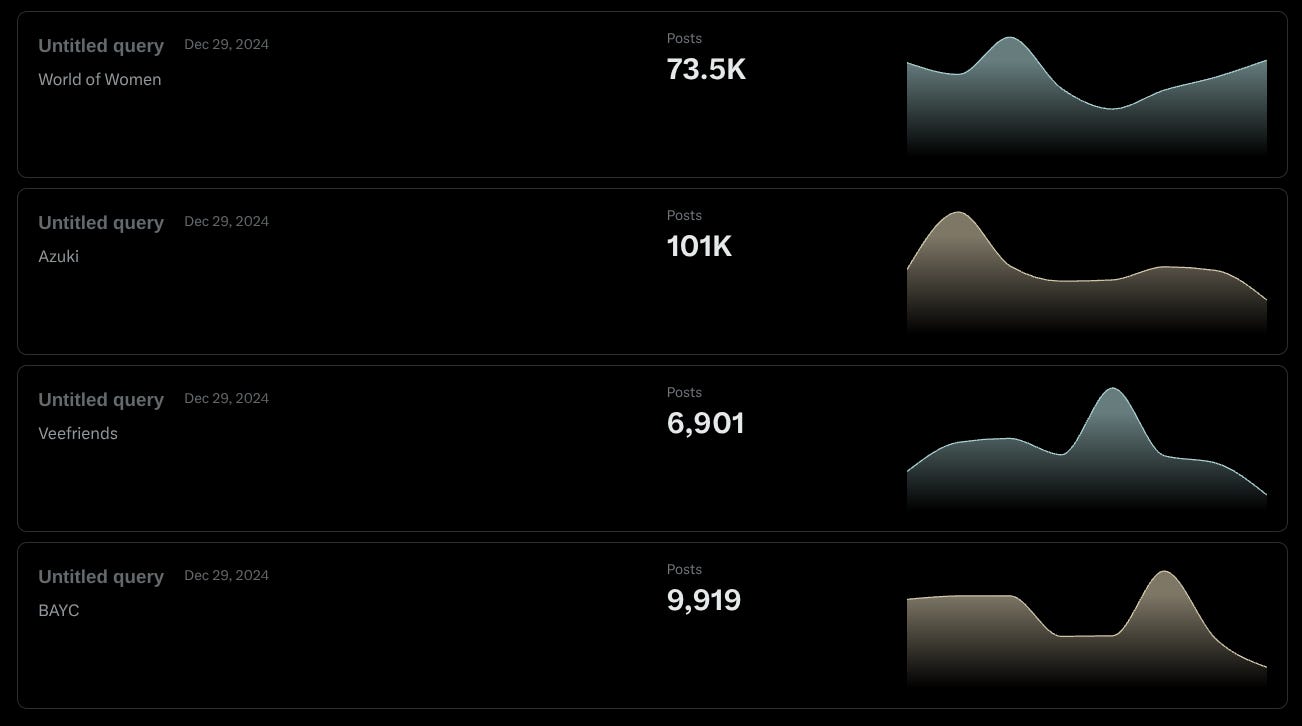
Right now, we’re at the start of a new cycle and sentiment around these assets is picking up, and so is the social media mindshare.
Stimulus is ready to flow into the system, interest rates are expected to come down, the ISM is showing signs of recovery—all of which means people will have more discretionary income and will rotate back down the risk curve sooner rather than later.
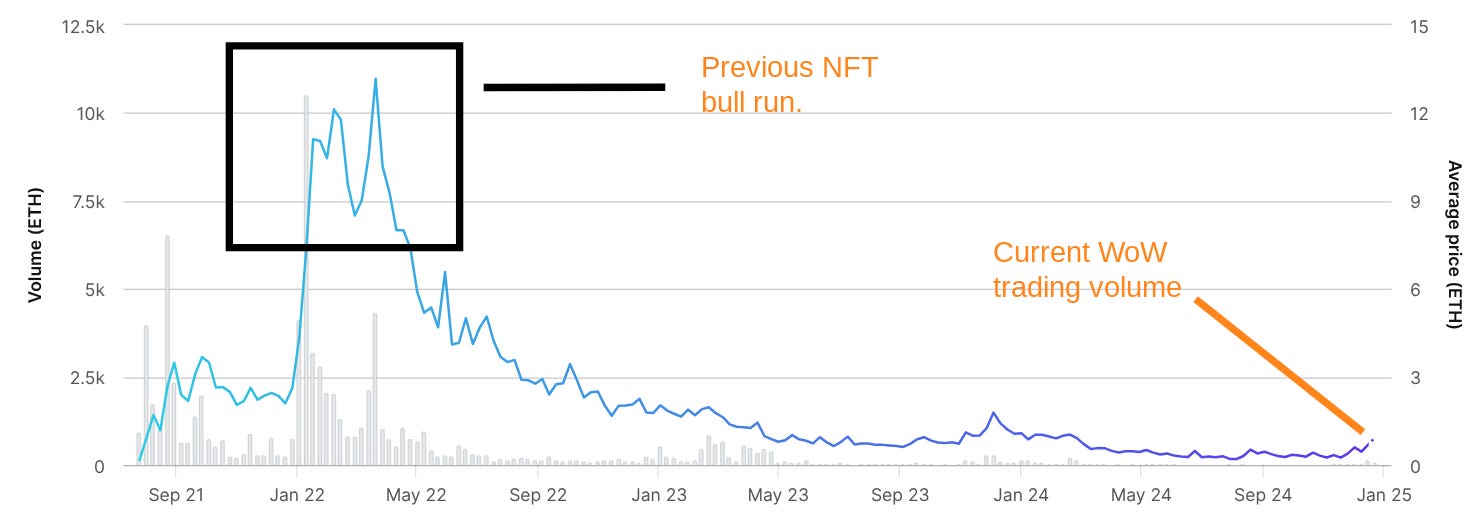
We can see some early signs that NFT trading volume is starting to increase.
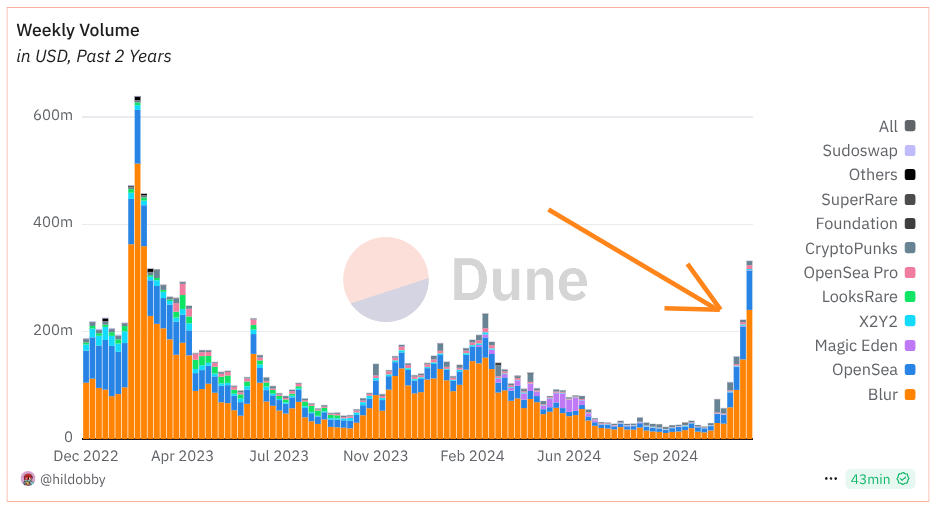
The entry price for WoW—given its previous highs and anticipated demand is criminally low, given that the entire space between 2021 and 2023 had around 23 million participants but is likely to grow to over 160 million this cycle if you look at a basic log trend of the entire crypto market cap (7x).
With this project sitting in a sweet spot, most likely having already seen its bottom, and the added potential/teaser of a token drop, it’s one to watch.
Heck, do your research—but I’m a buyer here.
Here’s the link to their OpenSea collection. I suggest joining their Discord to engage with the community and, most importantly, find something that resonates with you.
If you found value in this, please share it with a family member or friend. It’s how Carrot Lane grows.