

If you want to support the newsletter, get direct access to me, tap into the private community, or work with me one to one, you can check out the options below.
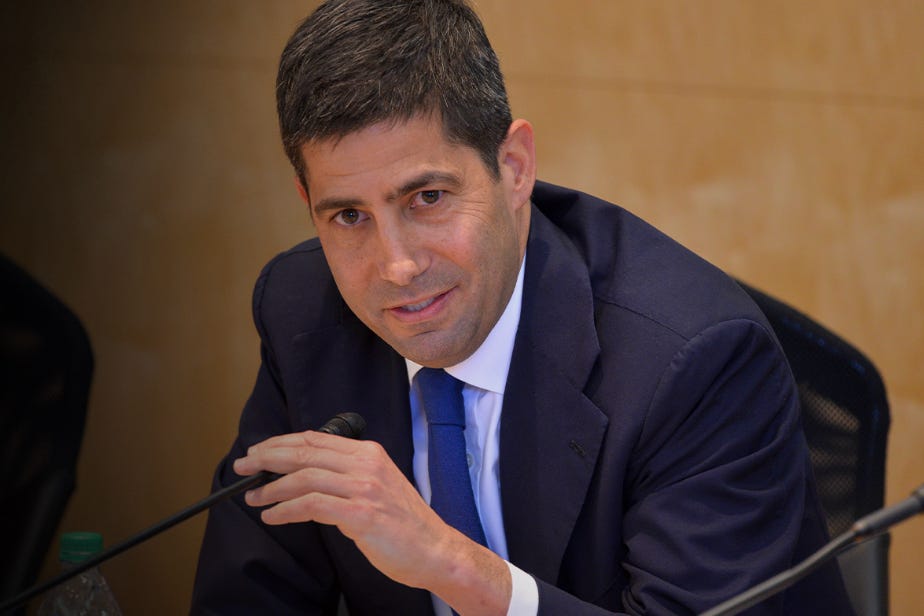
Kevin Warsh isn’t cut from the usual economist cloth.
The highly measured, articulate, and slightly self-deprecating soon-to-be Fed chair once put it like this:
“If we learned anything in economics, it’s that productivity gains come before wage gains. And if you can’t be part of that productivity revolution, then the story of the US being the shining city on the hill starts to look more like a myth.”
He sounds dovish on US growth.
He’s also adamant the country needs to lead the charge on AI. And yet at the same time, he’s famously hawkish on inflation. Or at least, that’s how it looks on the surface.
Not long after Trump announced Warsh as Jerome Powell’s successor, gold, silver, and Bitcoin assets began to nuke, which the market read as “he’ll keep rates higher for longer”.
It’s the mistake every Tom, Dick and Sally is making.
Warsh grew up in upstate New York, and as a teenager, he was selling race programmes at Saratoga Race Course. Didn’t take him long to figure out a little trick to juice his tips.
He’d give eight different customers eight different horses, telling each one his “lucky pencil” had picked a winner. By the end of the day, one of them would come back convinced he was a genius and tip him accordingly.
Warsh later joked it was a foolproof way to pocket a nice bonus on big race days. Early lesson in finance, too. Always hedge your bets.
He’s not exactly short on connections either. Warsh is married to Jane Lauder, the billionaire heiress and granddaughter of Estée Lauder, as well as the daughter of billionaire businessman Ronald Lauder.
Trump once described him as “central casting,” while the media were a bit less generous, slapping him with the “nepo baby” label.
Where things start to get a bit murky is with those ties. Ronald Lauder has long been a major Republican donor, dropping $5 million into MAGA Inc in 2025.
He’s also an old college friend of Trump and is widely credited with first floating the idea of the US buying Greenland, partly for its mineral wealth to support AI expansion, and partly for its strategic value.
In interivew Lauder was quoted:
“Trump’s Greenland concept was never absurd, it was strategic. Beneath its ice and rock lies a treasure trove of rare-earth elements essential for AI, advanced weaponry and modern technology. As ice recedes, new maritime routes are emerging, reshaping global trade and security.”
These ties have naturally sent the spotlight burning a hole through Warsh and his potential appointment as Fed Chair, especially given the role is supposed to be strictly impartial and politically independent.
That independence exists for a reason. It’s there to stop things collapsing like a Jenga tower once rate decisions get heated, and to keep policy grounded in data, not political pressure or short-term election cycles.
And we’re already seeing how messy that can get. Jerome Powell, the current Fed chair, has come under fire, being called “mentally troubled” and “grossly incompetent” by Trump for not cutting rates.
Kevin Warsh is human, and these ties give you a rough idea of where he might lean and how he could shape monetary policy.
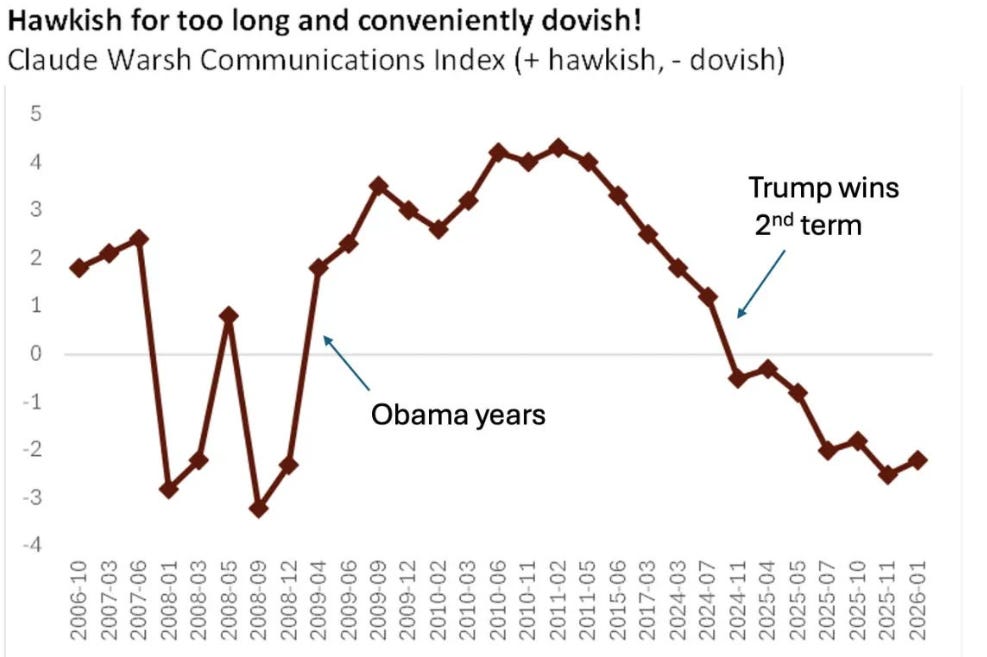
He served as a Federal Reserve governor during the 2008 financial crisis, one of the youngest ever to do it. Even as the economy was dragging itself out of the Great Recession, he stayed firmly hawkish on inflation. That didn’t go down well with everyone, especially with Democrats under Obama in power, and earned him the “political weathervane” label.
Now it looks like his next bet could flip the script. Lower rates, push productivity, and lean on AI to keep inflation in check.
“We can’t make any perfect predictions, but my guess is this is the most productivity-enhancing wave of our lifetimes, past, present and future. The way I think about it is the cost of curiosity is now zero.
When I was in public school, even the cost of curiosity had friction. When I showed up in California for the first time during orientation, you still had to go to the library and dig through a card system, even if it was on a computer, just to find a book. So it’s a very big deal that the cost of curiosity is now zero. The fruits of knowledge from that curiosity are now larger than ever before.
For most of the last 20 years, what we would say in economics is that the best of everything accrued the most significant gains. The best basketball player, the best violinist, the best programmer, the best mathematician, the best of everything.
At this moment that’s probably still true, because the world is changing so quickly. Market structures are changing and businesses are being redefined. So the question becomes: what country is most likely to benefit the most from the cost of curiosity being zero and the fruits of knowledge being as large as ever?
I think it’s the United States. That might sound like a very parochial view from a has-been government economist, but I believe it. I think the best companies in the world are here and the most talented engineers are either here or want to come here. That’s an amazing development.
So this productivity wave should happen in the United States first. It won’t happen evenly, but those that strike first and drive productivity first will differentiate themselves from their peers in their industry. They’ll have higher margins, bigger market share and a larger opportunity.
That’s why I think it’s such an exciting moment for the United States.”
The anecdotes are showing up before the data.
Official economic data is always late to the party.
Warsh’s view is that during big tech waves like AI, the data understates what’s actually happening. On paper, it looks muted, while the ground under people’s feet is already shifting. He says you can see the anecdotal evidence, but the numbers just haven’t caught up yet.
That leaves policymakers with a tough call.
Productivity could be quietly improving, but the official stats won’t reflect it for a while. So do you trust the data, or what’s happening right in front of you?
The Federal Reserve Bank of St. Louis dug into this, and the numbers are pretty telling.
In the first three quarters of 2025, AI-related spending added 0.97 percentage points to real GDP growth, or 0.90 without data centres. At the peak of the dot-com boom in 2000, that number was 0.81.
It’s not just the contribution either. AI made up 39% of total GDP growth in 2025, or 36% excluding data centres, compared to 28% in 2000.
So while people are still debating whether AI is overhyped, it’s already doing more heavy lifting than the internet did at its early peak.

Warsh’s view is pretty blunt.
Central banks and governments will have to choose between trusting lagging data and trusting what’s actually happening on the ground.
Because if you wait for the spreadsheets to catch up, you’re already behind.
And history tends to play out the same way every time. When technology spreads, it drives costs down.
“For has-been government economists like me, we’re going to look at the data. And I don’t think the data will show these productivity gains for many years after the anecdotes reveal them.
What’s that Bezos quote? “At moments of huge consequence, at turning points, if you have a set of data telling you one thing and a set of anecdotes telling you the other, listen to the anecdotes.” One hundred percent. I think Jeff is exactly right.
The anecdotes have already started to turn.
The difficulty for policymakers, whether that’s central bankers or fiscal authorities, is that the economy is going to be growing but it won’t show up in the productivity statistics for a while. So they’re going to have to make a bet. Is the economy actually becoming much more productive? Is the technology spreading into more sectors? And what should they do about it?
My simple version of this is that everything technology touches gets cheaper.”
Warsh looks set to run the Greenspan playbook
Alan Greenspan saw something everyone else missed.
In the mid 90s, while most economists were panicking about an overheating economy and calling for aggressive rate hikes, he took the opposite view. He bet that technology would do the heavy lifting.
His thinking was that the rise of computers, software, and the early internet was making businesses more efficient. More output, less cost pressure meant growth without the usual inflation spike.
Many of his contemporaries wanted to slam the brakes on the economy, but Greenspan held off on raising rates. He kept rates relatively stable and let the economy run hotter than normal.
The approach earned him a reputation as a masterful technocrat, capable of steering markets with precision.
He trusted the tech wave more than the traditional playbook.
“If you’re looking at the data, my view is you’re backward looking. You’re going to be late. You’re not going to realize the country is able to have non-inflationary growth faster.
So you’re going to have to make a bet.
The closest analogy that I have in central banking is Alan Greenspan in 1993 and 1994. The internet revolution was with us. He believed, based on anecdotes and rather esoteric data, that we weren’t in a position where we needed to raise rates because this technology wave was going to be structurally disinflationary.
A lot of his peers at the Federal Reserve, and certainly in the academic profession in economics, said the economy was overheating and that rates needed to go up because it would be inflationary.
But he sat on his hands and persuaded his colleagues to be patient.
As a result, we had a stronger economy, more stable prices and greater U.S. competitiveness.
I suspect that over the next couple of years, that decision will become central to the Federal Reserve and other big central banks.”
Bitcoin is the new American dream.
The current Fed chair, Jerome Powell, hasn’t exactly been a fan of Bitcoin.
Or the wider crypto space.
He once said “relatively unsophisticated investors” chase price when it’s going up, and warned there’s no promise it continues.
He’s also been clear that cryptocurrencies aren’t real currencies in his eyes. No intrinsic value. Not backed by the government.
It’s night and day compared to Kevin Warsh. He’s described Bitcoin as “just software”, but meant it as a compliment. A well-designed system that competes with traditional finance.
“For all of our fellow Americans, that lets them get a piece of the American dream without going through some labyrinth that costs them five percentage points right off the top. That’s the market opportunity.
I think it’s good for the United States, and I’ll make a final point. I think it’s good for competition in financial services.
If I were being really honest about my time in government, I served during the ‘08 financial crisis. What I would have hoped after the crisis is that we’d have a more competitive banking system.
Instead, we have a less competitive banking system.
That’s the market opportunity, and technology has a way of driving a set of products and services now that was probably impossible 5 or 6 years ago.”
Final Thoughts.
This whole thing has a bit of a family affair feel to it, mixed with some insider baseball.
Warsh’s family connections aren’t nothing. And the idea that his decisions could tilt toward keeping voters happy as midterms approach is far from far-fetched.
Trump posted to his Truth Social:
“I have known Kevin for a long period of time, and have no doubt that he will go down as one of the GREAT Fed Chairmen, maybe the best. On top of everything else, he is “central casting,” and he will never let you down.”
And in a completely opposite tone, Senator Elizabeth Warren came back with:
“Kevin Warsh spins fairy tales about the president, he’ll say anything President Trump wants him to, doesn’t matter whether it’s true or not. That blind loyalty to the president is nothing short of dangerous. He’s a sock puppet.”
Stepping back from the politics and philosophical whataboutsm for a sec, the real question is simple. What does this actually mean for us?
From where I’m sitting, it looks pretty bullish, particularly for risk assets like Bitcoin and Crypto, given that he’s pro-Crypto and technology.
It’s plausible that AI is already boosting business productivity in ways we can’t fully see yet. And if that’s the case, the play becomes obvious. Lower rates, backed by the belief that AI-driven efficiency will keep inflation in check.
These are favourable conditions for risk assets.
Trump’s been going after Uncle Jerome for not cutting rates for what feels like forever, while also shining a spotlight on Warsh, a Republican who fits the mould.
And if you want a hint of how this might play out, look back at Warsh’s time during 2008 under Obama. His tone on inflation was very different to what we’re seeing now.
He only seems aggressively hawkish when Democrats are in charge and prepared to print when Republicans are at the helm.
America needs to be first to the productivity-inducing technological shift to enjoy the outsized results it has had.
Warsh believes policymakers should act on common-sense, anecdotal evidence that A.I. will create a deflationary shock faster than people think, because it’s here now, but not showing in the data, because everything we use to measure performance lags.
I agree, maybe from a self-interest point of view, that we need to lower rates, which will lead to the US rolling over its debt, of which about 24% of the $38 trillion is due in 2026.
Whether people in crypto like it or not, rate cuts are the silver bullet. You can argue narratives all day, but when rates come down, liquidity picks up, and risk assets move. It’s that simple.
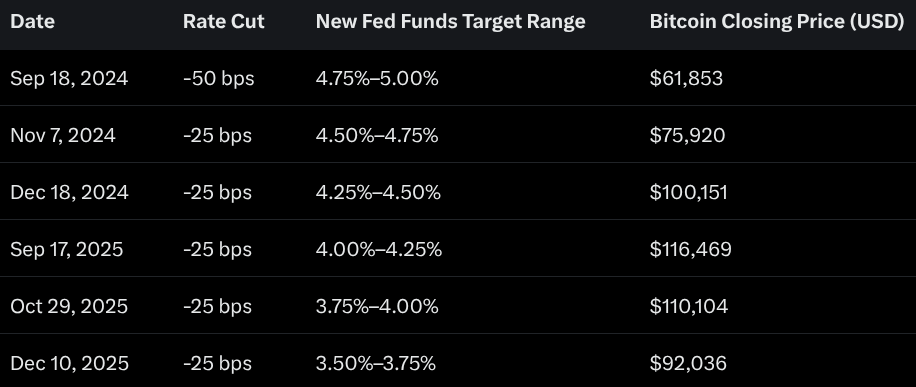
The last six rate cuts tell the story. Bitcoin went from around $60k to over $110k during that easing cycle.
Lower rates don’t guarantee instant pumps, but over time, they stack the odds heavily in favour of assets like crypto.
My view is simple. A well-connected economist, acting on signals most people can’t see yet, is going to cut rates.
As soon as he steps into office.
If that happens, we go much higher.
If you want to support the newsletter, get direct access to me, tap into the private community, or work with me one to one, you can check out the options below.
This article is for informational purposes only and should not be considered financial, tax, or legal advice. You should consult a financial professional before making any significant financial decisions.