


Today’s newsletter is free thanks to paying subscribers. Consider upgrading to receive community benefits and to support the work I do here.
I had a fascinating conversation with a Coinbase exec recently.
It gets to the heart of how people misunderstand crypto value.
As I sat down for a swank lunch, we got into the customary "what assets are you into" chat. I always feel like you can tell a lot about someone by what they buy.
I was pretty honest. I said I was bullish on SUI, and he replied with, “I’m into Solana but not really looking to get into another L1, to be honest. That, and Raoul Pal is heavy into SUI, and it feels like he’s tryna pump his bags”.
I always like it when someone has an informed opposing view, so I asked what he honestly thought about Sui. He replied, “Not really anything happening on the chain yet, so you don’t really know whether it’s going to be a great trade.”
I agree.
The trade has always been to act with incomplete information, using early-mover advantage based on the team's capability, the technology, and price performance against other assets.
More on that in a sec.
Now, I actually think using RP as a safety signal is pretty smart. But it isn’t the crux of my thesis. I invested in ETH in 2017 and then saw a very similar behavioural pattern with Solana in 2021, when I got in relatively early, and again when it got absolutely nuked to $8 from its $250 (ish) high after the FTX debacle.
Price is largely unimportant for now because these assets are so heavily correlated with Bitcoin. So you have to pop the bonnet and see what’s actually going on.
The more interesting question is why you would invest in a Layer 1 versus almost any other token. And the answer is incredibly simple. You’re not trying to pick the individual applications that will win. It’s almost like buying an index fund or a basket of assets instead of trying to pick individual winners.
Competition at the application layer is fierce, and you’re essentially making singular bets on individual companies. Over time, the leading apps will change hands multiple times, but the rails they’re built on don’t necessarily change with them. In fact, if the network keeps attracting developers, applications, users, and capital, the value of those underlying rails can compound as the ecosystem built on top of them grows.
That’s what I saw with Ethereum, coined the open-source app store of the internet, and then Solana, an Apple-like ETH competitor, being the closed-source app store, and it’s why I’m paying such close attention to Sui now.
Cosmo Jiang, general partner at Pantera Capital, who has $3.5 billion in assets under management, explained the Layer One trade in a fiery debate at Solana Breakpoint on layer ones. He nailed it.
“Applications will always create enormous value. Some will be very valuable businesses. But the idea that this happens instead of value accruing to the L1, or that more value accrues to applications than the L1, is false. In every crypto application, applications monetise users, they monetise activity. But Layer 1s monetise all that activity, plus the monetary capture on the base layer. Every application, no matter what it is, has to live on an L1. It has to pay rent to an L1. When you think about what apps are, apps are like stores at a mall. They pay rent and they benefit from the traffic and the users that exist in the mall. Well, the mall owner (L1) is the one that is more permanent and actually captures the value and collects rent from all the application owners and all the stores.”
The signals show up before the price
Tim Draper once said, and I’ll paraphrase here, something like: when price languishes for ages, people attack the technology when it’s not quite consumer-ready, but engineers continue to work their asses off.
He famously called this concept the Draper I S curve.
“Every industry goes through this. There is a little ‘i’….that’s the hype. It comes to a point (the dot on the i), and then it comes down because people are disenchanted. It sits there while engineers are hard at work, and then it grows into a big ‘S’ that goes way bigger than the top of the i.”
Take, for example, the Amazon chart below.
The dot on the “i” was the dot-com bubble bursting, the most significant drawdown or market crash in our history, and you literally can't even see it on a chart. What followed many years later, now that we use Amazon for ordering basically anything online, was the massive S.
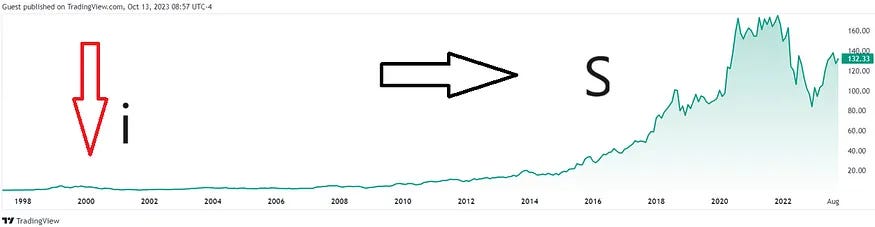
It makes you realise this is true of basically every new technology.
It has a false start, and I saw that with ETH in 2018, Solana in 2021, and now SUI in 2026. The price was showing strong potential but needs to find its use case.
Solana and Sui are both high-performance Layer 1s fishing in roughly the same pond, but right now they’re at very different points in the journey. Solana is the battle-tested older brother.
You can see it in the developer activity.
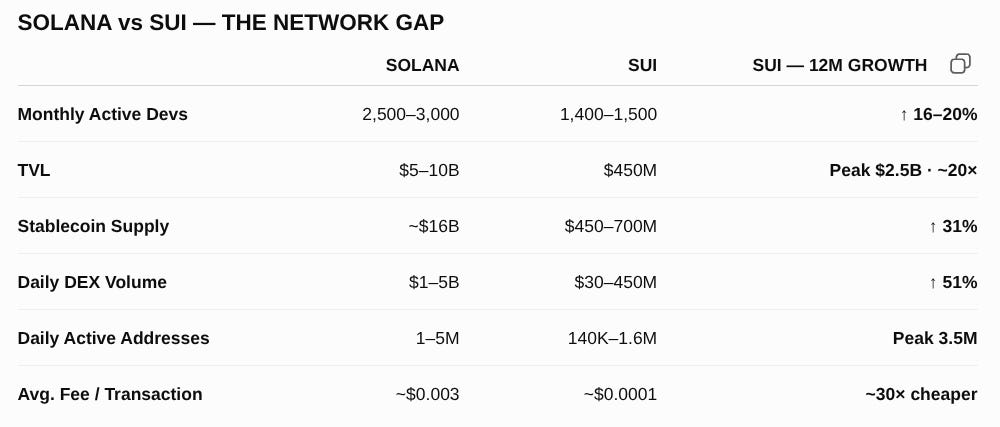
Solana still leads with roughly 2,500 to 3,000 monthly active developers, while Sui sits around 800 to 1500. But that gap is probably more interesting than it looks. Sui is much younger, and its developer base has been growing quickly.
Developers build the shops (apps) that drive foot traffic (users), which increases transactions and helps the shopping mall (layer 1) collect rent.
Sam Blackshear, the creator of the Move language protocol for SUI, shared developer data recently:
“Sui highlights from EC mid-year dev stats refresh:
- Sui is the 2nd fastest growing L1 dev community over the last year at 16.1% -- just a hair behind Solana at 17.7%.
- Sui is the fastest growing L1 dev community over the last two years at 54%
- This goes against broader growth trends--total crypto devs is down ~20% in the last year and all major EVM L1s had negative dev growth in the past year
- Sui remains the largest, fastest-growing, and most vibrant Move developer community”
TVL is where Solana really stretches its legs.
It has around $6 billion locked across the network versus roughly $450 to $500 million on Sui. No prizes for guessing which ecosystem is more mature. Solana has deeper liquidity, more established applications and a much bigger pot of money sloshing around.
Stablecoins tell much the same story.
Solana has roughly $16 billion sitting on the network compared with around $450 to $700 million on Sui. That matters because this is actual capital sitting there ready to be put to work. It’s one thing to have people kicking the tyres. It’s another having billions of dollars parked in the garage.
DEX volume is equally lopsided.
Solana can do anywhere from $1 billion to $5 billion a day, while Sui is currently somewhere around $30 million. Again, Solana wins today because it is much more established, but the rate of change matters.
Daily active addresses start making things a little spicier. Solana regularly sees between one and five million, while Sui has ranged from around 140,000 to 1.6 million and has peaked at 3.5 million. For a network this young, that gets my attention.
Then there are fees. Sui transactions can cost around $0.0001, roughly 30 times cheaper than Solana. I’m not suggesting cheap automatically means better. You can build the world’s cheapest ghost town, and nobody cares. But when cheap transactions sit alongside rising developers, users, and liquidity, you’ve got something worth watching.
That is really the crux of my Sui thesis. I’m not trying to argue that Sui is bigger or better than Solana today. It clearly isn’t. In fact, it's better that it isn’t because it takes less buying pressure to move higher.
It is starting to show some of the same footprints Solana left behind before everyone decided Solana was obvious.
Price tells a story.
The size gap between Solana and Sui is enormous.
Solana is roughly a $60 billion asset, while Sui sits closer to $3 billion. That makes Solana around 20x larger.
When both assets are correlated with Bitcoin, Solana needs 20x the buying pressure to keep pace with SUI. The concept is simple: for you to double your money in SUI, the market cap needs to go from $3 billion to $6 billion. With Solana, it needs to go from $60 billion to $120 billion.
When both are simply correlated with Bitcoin, the smaller, newer, less liquid network is more likely to rise faster. This stuff is simple.
If you have one person in a network and another person joins, that’s a 100% increase. If you have 100 people in a network and one person joins, that’s only a 1% increase. The bigger the network becomes, the more demand required to maintain the same percentage growth.
You can see from the chart below that the three assets are the same bloody chart. They’re a mirror image of each other.
Bitcoin (orange) goes up in price. Solana (blue) and SUI (green) rise optically. The same happens on the downtrend. When Bitcoin bleeds, Solana and SUI get pneumonia. Solana is 83% correlated to Bitcoin in the last 12 months, and Sui is 80% correlated.
That tells me there is enough copycat behaviour around Bitcoin to suggest the real bet is: does Bitcoin go up in price? My answer is an emphatic yes.
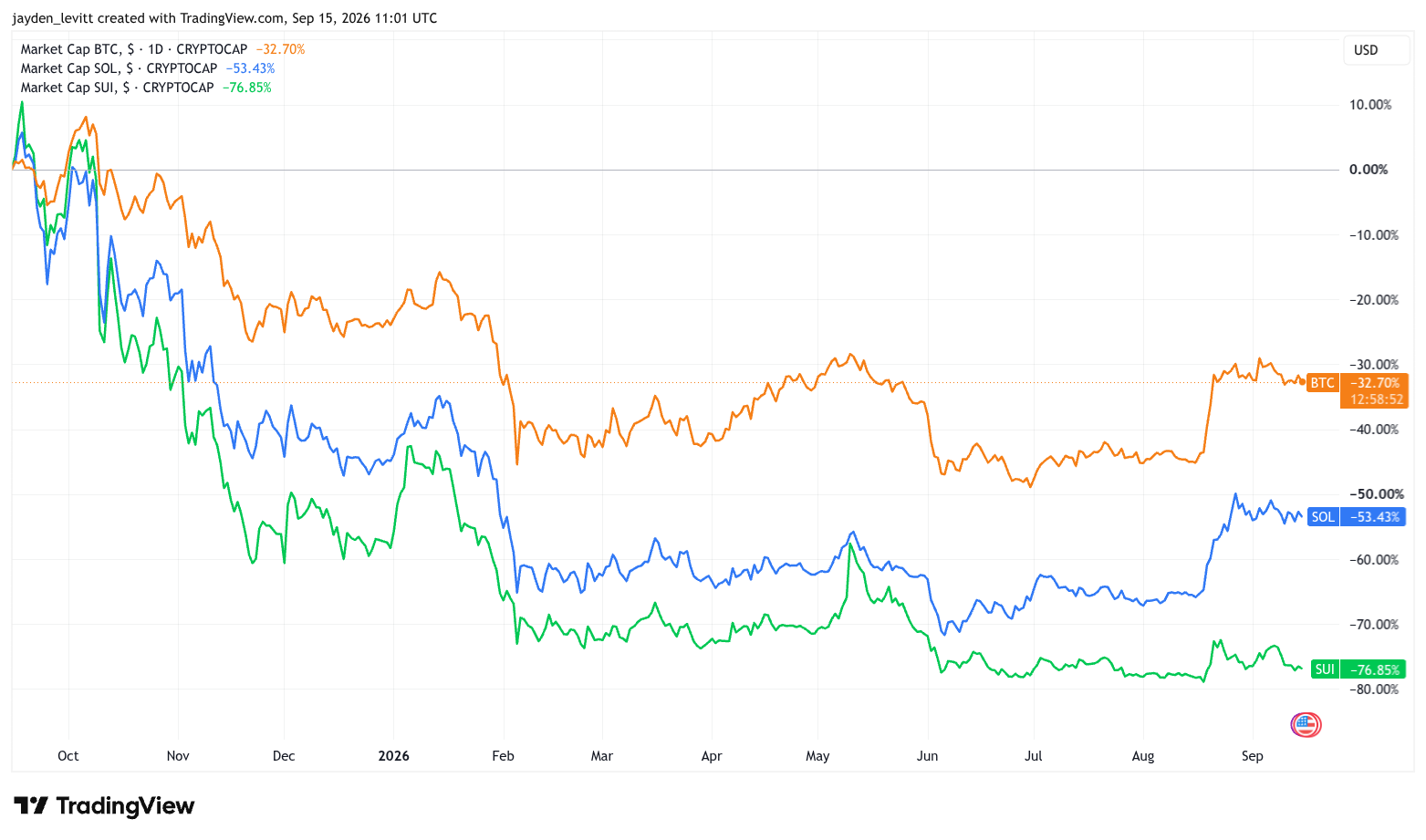
The more interesting part is the longer-term chart.
SUI breaks out against other assets over two years, and its correlation is closer to 60% with BTC.
Remember, price is proportional to network growth, like new wallet addresses, developer activity and transactions. So you just use price as your north star.
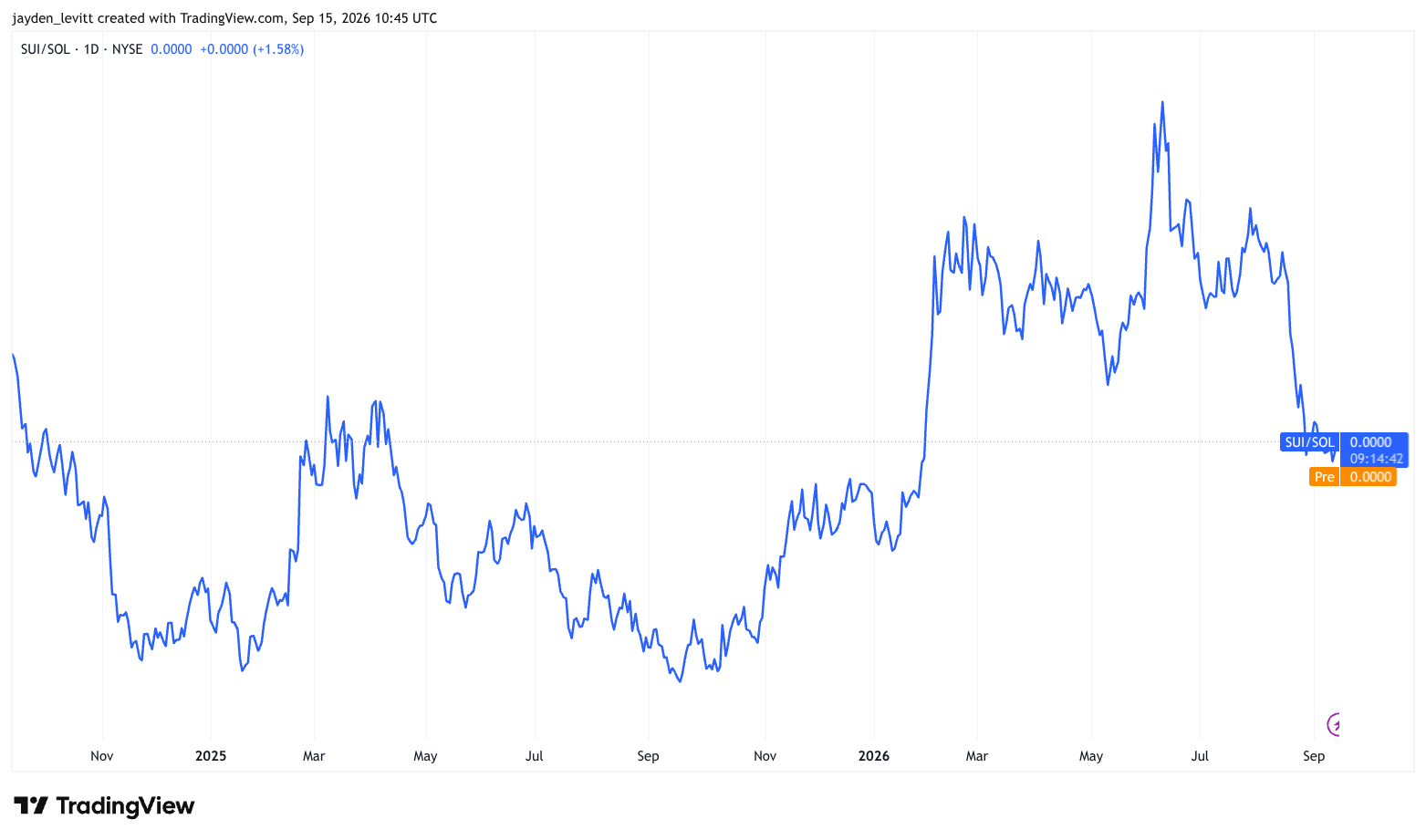
When you want to whittle things down and find observable value, using this pair method, or a cross method of pairing assets against each other, gives you a much clearer view of how the market is actually pricing them. It allows you to see which asset is genuinely gaining or losing strength relative to the other.
Solana has graduated from being “crypto beta” to a bona fide blue chip. It’s now larger, more liquid, widely listed, and increasingly sits in the same institutional baskets as Bitcoin.
When the tide comes in or goes out, the same desks often buy and sell both.
It trades a bit like Bitcoin after three espressos.
Sui is still much more of an individual project.
At around $3 billion, you’ve got thinner liquidity, lumpier buyers, token unlocks, market makers and ecosystem-specific news all pushing and pulling on the price.
However, when you pair SUI with SOL, you can see it outperforms on price and has broken out against Solana.
I have said many times on record that Solana is probably the best risk-adjusted asset, established enough to add with size, but SUI's price performance will probabilistically outperform it.
Final Thoughts.
An old business partner once said to me that most people have great ideas, are creative, and even have the money to splash into a business, but most don’t have the kahunas to see it through when things get tough.
I see that behaviour in Crypto investors often.
I get it. In any normal world, when an asset is down so bad you think it’s dead and buried, pushing up daisies, but it’s not. It's Uncle Tim Draper’s “I” s curve playing out as normal. Developers are working their tits off.
By the way, so am I. If you’re a free member, please consider a paid subscription.
This trade is beyond simple.
It’s a bet on Bitcoin, provided SUI maintains its correlation with Bitcoin and the developer activity continues at the current rate of change in an uptrend I expect this asset to do well. The low float should create supply friction, which will amplify upside moves.
But the double-edged sword is that you have to grin and bear the stomach-churning drawdowns.
I don’t know whether Sui becomes the next Solana. Nobody does. What I do know is that I’ve spent eight years watching this market, and I’ve seen Ethereum go through this process. I’ve watched Solana copy its older brother's PTSD when Sam Bankman-Fried nuked the market.
The volatility is just a function of how these assets work. The developer activity is undeniable.
What would really be icing on the cake is a significant use case for SUI, on top of the already obvious developer activity, price performance in an uptrend, and correlation with Bitcoin.
It happened with my Solana bet.
It’s why SUI is giving me déjà vu.
This content is for informational purposes only and should not be considered financial, tax, or legal advice. You should consult a financial professional before making any significant financial decisions.
Great comparison....thanks 👍
I currently own both at almost equal weight.